I’m sorry if this post will be slightly longer than usual, but when I started this website, I decided to create something honest and genuine, without limitations and self-censure. Probably all of you guys are more than fed up with my favorite Oscar Wilde quote (“Be yourself. Everyone else is already taken”), but the truth still lies somewhere here: artists have a chance to create something meaningful only through genuineness and honesty – even if it results in long and exhausting blogposts, clearly kicking over the alleged “rules” of social media to write concise posts and bold statements.
To start with, let me tell you that recently I got extremely thought-provoking reviews on many of my songs. The feedback basically came from two major sources: (1) I showed a couple of tracks to curators of metal playlists and blogs for consideration to stream/publish on their respective platforms, and (2) being intended to represent the Roman Catholic mass in an expreimental way, my Missa Innominata was presented to a group of musicians involved in religious music. The outcome of these discussions were two-fold. First of all, while almost everyone affirmed that the songs are well-written, well-played and inventive (I was absolutely honored by this incredible feedback btw!), many of my reviewers and listeners claimed that they would perform better, if they contained lyrics and vocals. Besides, Missa Innominata triggered an interesting and inspiring discussion on the abilities of instrumental music to represent and express spirituality. Altogeter, both lines of feedback led in the same direction, raising questions about the legitimacy and viability of instrumental rock/metal music in our contemporary musical culture.
Interestingly, no such questions are posed to – for example – instrumental jazz, which is generally considered a legitime way to express feelings and thoughts. The answer may lay in the alleged (or rather hypothesized) nature of metal music, a genre that has long been marginalized due to its undoubtedly nonconformist character held by many as a rebellious and unpeaceful way of opposing traditional values and lifestyle. Metal, is usually considered to be able to express only negative feelings like rage, hatred or sadness – however, the truth is that it’s not even a single entity, but rather an umbrella term for a variety of different characteristically distinct subgenres. Without the urge to defend something that actually doesn’t need to be defended, let me emphasize that this diversity renders metal music capable to express feelings and emotions on an extremely wide spectrum. Although the “faces” of instrumental rock/metal – guitar virtuosos like Joe Satriani, Steve Vai, Buckethead or Tony Macalpine – put an enormous emphasis on technical perfection, many metal bands incorporating instrumental tracks in their albums concentrated on inventive songwriting and harmony progression rather than personal shredding abilities (two of my favorites are A Day at Guyana from Agent Steel and It’s a Secret from Metal Church). Instrumental metal, therefore – like every other musical genres – has unlimited (however, still unexploited) abilities in this regard.
This clearly constitutes an unmet need – a niche that must be filled sooner or later. While I’m well aware that most people can “get into a song” primarily through lyrics, I look at instrumental metal music as an endless possibility to be exploited and utilized. I am convinced that music in general may substantially profit from the textualization of thoughts and feelings: lyrics can create an added value that might lead the listener into the deepest layers of the composer’s soul. Still, certain types of music doesn’t need lyrics to transmit these feelings and emotions – it depends on the character of the music. The absence of lyrics may provide an enormous opportunity for the listener to interpret the harmonies and melodies in a completely free way. I must admit that I myself experimented quite a lot with lyrics – still, my current creative process is based on playing the guitar. I, therefore, found my own lyrics artificial and inappropriate.
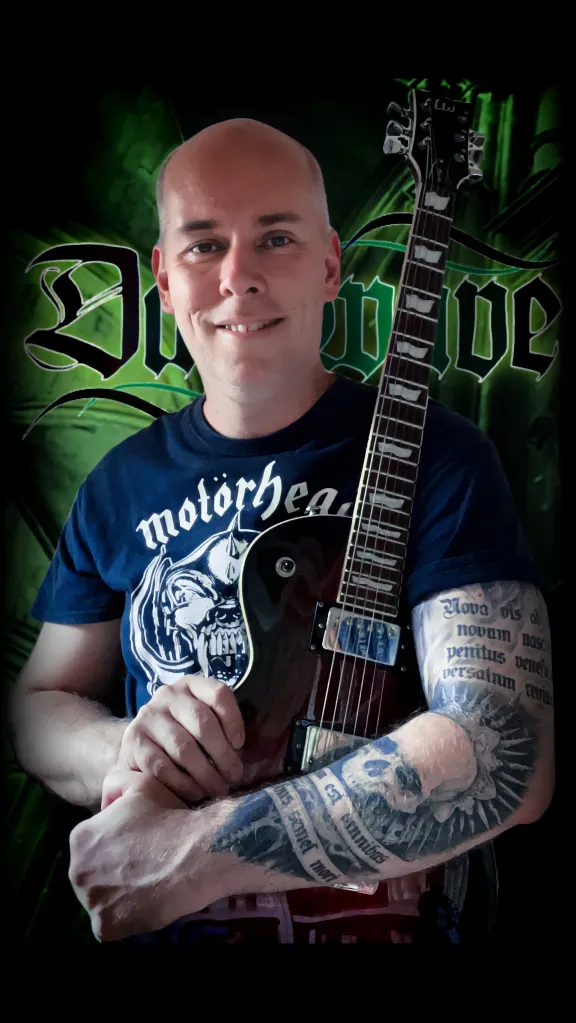
So, what now? Nothing, I suppose. I will continue making instrumental music until I feel that the presence of words become crucial for me to express something specific in my songs. While I don’t exclude the possibility to write music with lyrics and vocals in the future, my present ideas for my two or three new tracks are centered around my comfort zone by playing the guitar and composing instrumental music. I’m well aware that there’s are faster guitarists, better songwriters and definitely more good-looking guys out there than I am or will ever be – still, those two albums in the Releases section of this website are me: and in this sense of the word they are faithful reflections of their creator’s character. I hope you’ll find the third one an organic continuation of the previous two.