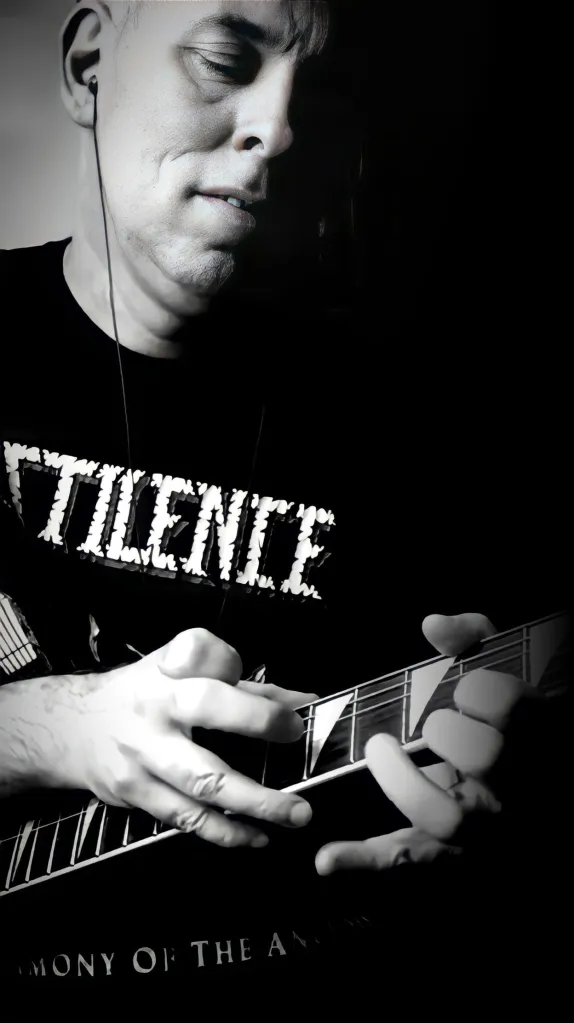
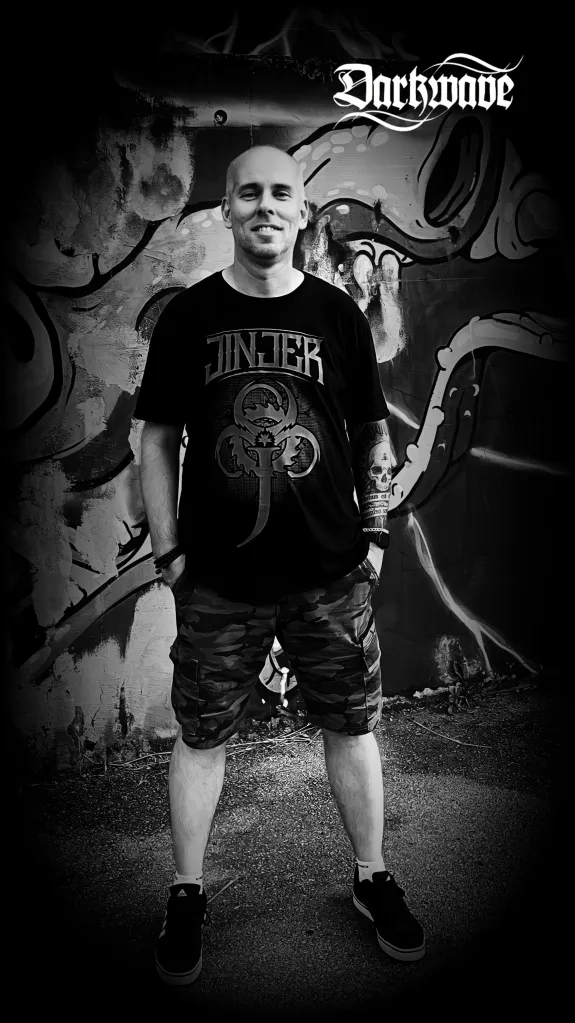
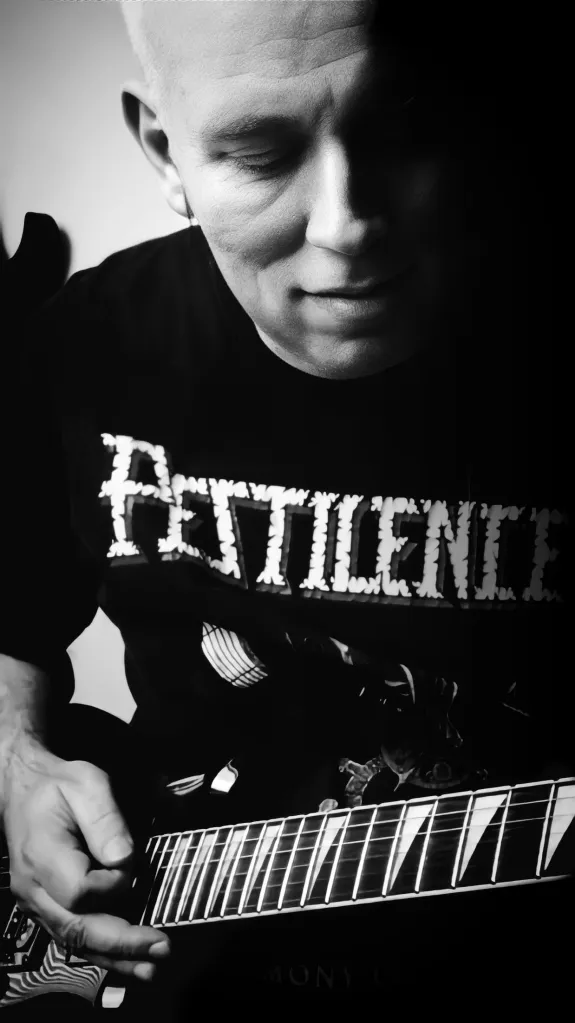
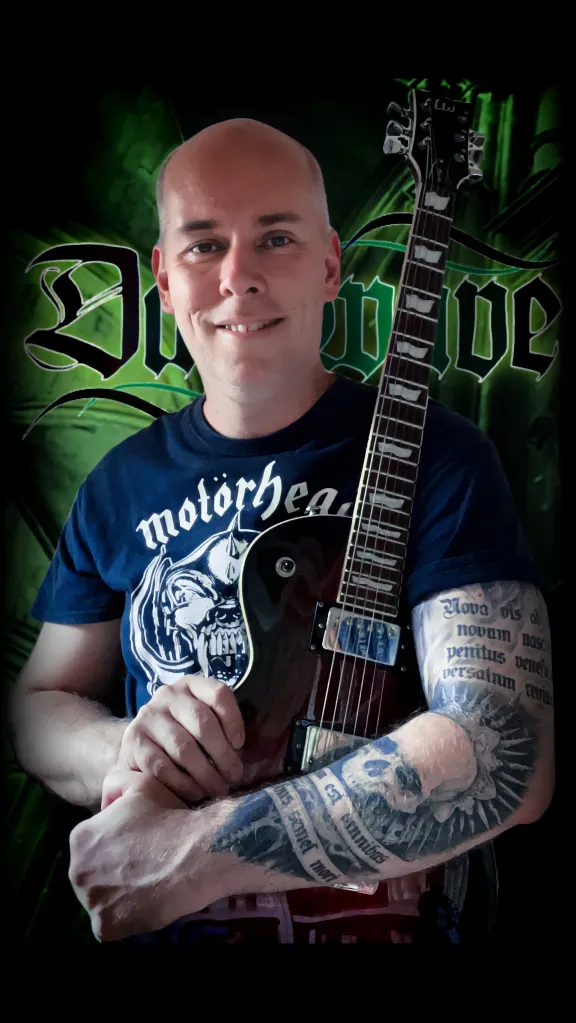
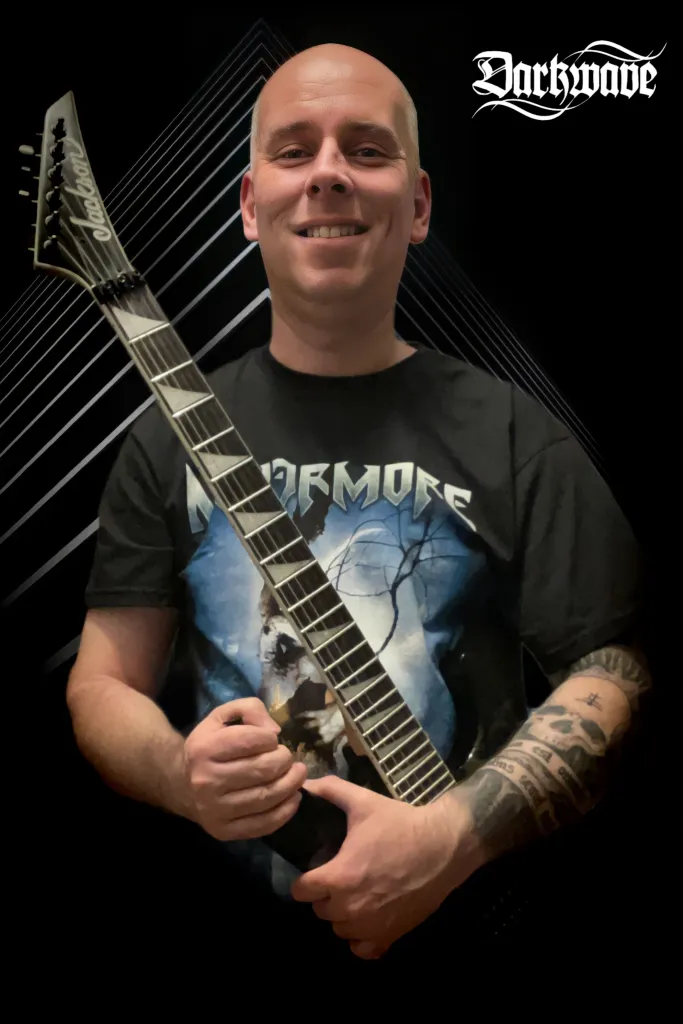
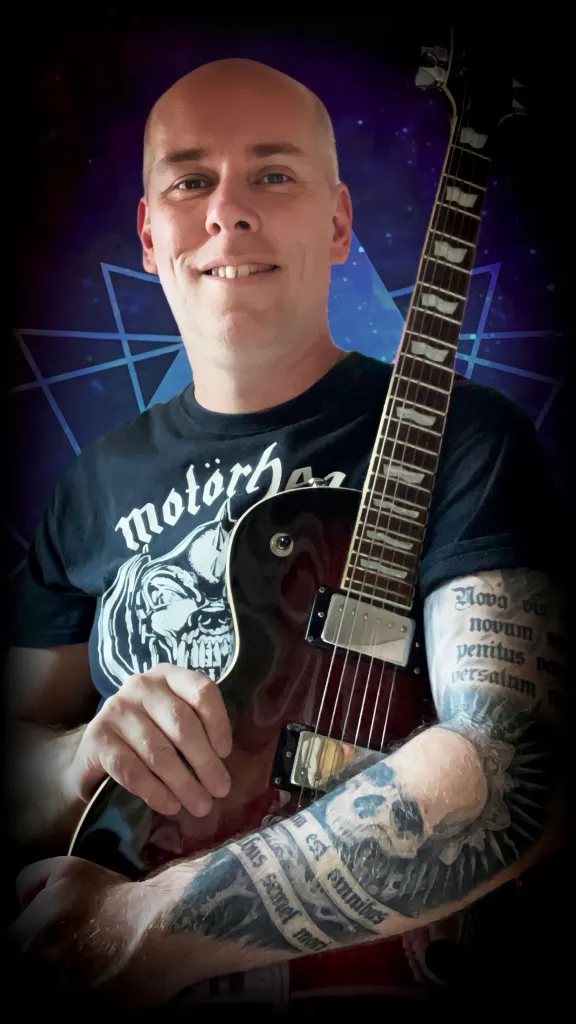
Darkwave began as a personal challenge: to create music entirely on my own terms. What started as a one-man recording project gradually evolved into something far larger – a vehicle for exploring questions of mortality, meaning, faith, loss, hope, and transcendence. Each album became not only a musical statement, but also a reflection of a particular stage in that journey.
Although the dream of composing and recording my own music had been with me for decades, the first demos of Hexapla began to take shape only in the second half of 2020. Created in a modest but well-equipped home studio, the album emerged during a period of both excitement and uncertainty. For the first time, I found myself responsible for every aspect of the creative process: composing, performing, recording, mixing, mastering, and eventually sharing the music with the world. At times, the scope of the challenge felt overwhelming. I even considered abandoning the project altogether. Yet music had always been one of the most meaningful forms of expression in my life, and the desire to communicate through it ultimately proved stronger than doubt. I wanted to know whether the emotions and ideas that had accompanied me for so many years could resonate with others as well.
Looking back, Hexapla represents something more than a debut album. It was the discovery of my personal musical language. Many of the elements that would later become characteristic of Darkwave first came together here: old-school metal riffing, progressive structures, orchestral textures, and a willingness to cross stylistic boundaries in search of something uniquely my own. Released on August 3, 2021, Hexapla was an instrumental album, as all Darkwave releases would remain until 2025. Built around the idea of unity in diversity, it sought to merge thrash metal with a wide range of influences while maintaining a coherent artistic identity. The concept extended beyond the music itself, from the song titles to the cover artwork created in collaboration with my longtime friend, photographer Dávid Ujhelyi.
As an independent musician with limited promotional resources, I had few expectations regarding the album’s reception. To my surprise, Hexapla reached a growing audience and even entered SoundCloud’s RepostExchange Pop/Rock Top 40. More importantly, however, it confirmed something I had not fully realized before: Darkwave was no longer simply an idea. It had become a reality.
The creative process did not stop there. The more I experimented, the more I felt compelled to revisit and refine the album’s sonic world. This eventually led to Hexapla – The Remasters in 2022, a reimagined version that reflected both growing experience and a clearer artistic vision. The release received an enthusiastic response and was featured in Bandcamp’s New and Notable section shortly after its release.
Even as I was completing the remixed and remastered version of Hexapla, my thoughts were already focused on what would come next. The songwriting for Missa Innominata had begun almost immediately after the release of my debut album, and by the time the updated Hexapla appeared in 2022, I was already deeply immersed in recording its successor.
If Hexapla represented the discovery of a personal musical language, Missa Innominata became an exploration of how far that language could be expanded. While remaining rooted in metal, the album drew heavily from the monumental atmosphere of classical sacred music, liturgical traditions, and orchestral composition. It sought to unite the expressive power of metal with the grandeur and timelessness often associated with religious music. During the recording process, I even experimented with adding vocals for the first time. Although the idea was ultimately abandoned because the results did not meet my own standards, it foreshadowed a direction that Darkwave would eventually pursue years later. Released on June 1, 2022, Missa Innominata marked an important step forward both musically and conceptually. Looking back, it was the first Darkwave album to seriously engage with themes and aesthetics that would later become central to works such as Horror Sacri. The sacred, the transcendent, and the search for meaning began to emerge not only as artistic influences, but as recurring questions within the music itself.
The album received an even warmer reception than its predecessor, with one of its tracks reaching both the RepostExchange Pop/Rock Top 40 and the platform’s overall Top 40 chart. More importantly, however, Missa Innominata demonstrated that the creative path opened by Hexapla was not a one-time experiment, but the beginning of something much larger.
By the time work began on Thanatology, Darkwave had become far more than a creative outlet. What started as a personal recording project was gradually evolving into my primary form of artistic expression, a place where music, philosophy, emotion, and personal experience could converge.
The years leading up to the album were marked by constant growth. I refined my production techniques, expanded my technical skills as both musician and sound engineer, and continued searching for new ways to translate increasingly complex ideas into music. Yet the most significant development was not technical, but conceptual. Released on August 3, 2023, exactly two years after Hexapla, Thanatology became the most personal Darkwave album up to that point. More than a collection of compositions, it was a meditation on mortality, impermanence, and the fragile nature of human existence. Through its music, the album explored questions that had gradually moved closer to the center of my artistic vision: how we confront death, how we find meaning in a finite life, and how we live in the shadow of our own impermanence.
Looking back, Thanatology marked a turning point. While earlier releases had explored atmosphere, musical identity, and transcendence, this album brought existential questions fully into focus. Many of the themes that would later define Horror Sacri and Evanescent Horizons can already be found here in their earliest form.
The response exceeded anything I had previously experienced. The album attracted attention not only within the SoundCloud community but also among independent reviewers and metal publications. Metal Has No Borders included Thanatology among its Album of the Month honorable mentions, and the album later received Bronze Tier recognition in the publication’s Readers’ Metal Album of the Year poll. In addition, Thanatology became the first Darkwave album to receive a physical CD release, with a limited edition of 100 copies. More importantly, however, it confirmed that Darkwave had evolved into something larger than a musical project alone. It had become an ongoing exploration of the questions that would continue to shape every album that followed.
The years following Thanatology brought another period of transformation. In 2024, I undertook a comprehensive revision of the Darkwave catalog, remixing, remastering, and in some cases substantially reworking the project’s earlier releases. At the same time, I had the opportunity to collaborate with talented artists, explore new creative directions, and build friendships with musicians and listeners from around the world. Yet the most significant change occurred while I was working on demos for what would become the next album.
For years, Darkwave had been an instrumental project. Although I had occasionally considered adding vocals in the past, I had always concluded that the music itself was sufficient. This time, however, something felt different. The ideas I wanted to express had become increasingly philosophical, personal, and narrative in nature. Eventually, I realized that the next stage of Darkwave’s evolution required a voice. That realization led to Horror Sacri, released on August 21, 2025. If Thanatology confronted mortality, Horror Sacri confronted transcendence. Drawing from sacred imagery, biblical symbolism, and personal reflection, the album explored faith, doubt, spiritual collapse, and the search for meaning in a world that often appears silent. Rather than offering answers, it examined the tension between belief and uncertainty, hope and despair, longing and disillusionment.
The introduction of vocals transformed Darkwave in fundamental ways. For the first time, ideas that had previously been expressed through atmosphere and instrumental storytelling could be explored directly through language. Yet despite this change, the album remained faithful to the project’s core identity, combining progressive and symphonic metal with orchestral arrangements, church organ, and a strong conceptual focus.
Looking back, Horror Sacri represents one of the most important turning points in the history of Darkwave. It expanded the project’s expressive possibilities while bringing its philosophical concerns into sharper focus than ever before. The questions that had emerged gradually throughout Hexapla, Missa Innominata, and Thanatology now stood at the very center of the music.
In many ways, Horror Sacri was the album that made the next chapter possible.
If Horror Sacri explored humanity’s relationship with the sacred, Evanescent Horizons, released on July 15, 2026, turned inward. Rather than asking questions of faith, it asks questions of love, loss and the fragile resilience of the human spirit.
Conceived as an eleven-chapter concept album, Evanescent Horizons follows the emotional journey of a soul confronted with unrequited love, grief, anger, acceptance and, ultimately, the possibility of hope. While deeply personal in its narrative, the album seeks to speak to experiences that extend far beyond romantic love. At its heart lies a simple but profound question: can love retain its value even when it is never returned?
Musically, the album represents Darkwave’s most expansive work to date. Progressive symphonic death metal forms its foundation, enriched by cinematic orchestration, recurring musical themes and a carefully constructed emotional arc that unfolds across the entire album. Every composition was designed to serve the narrative, allowing brutality and vulnerability to coexist as equal parts of the same journey.
Looking back, Evanescent Horizons feels less like a departure than the natural culmination of everything that came before it. The search for identity that began with Hexapla, the fascination with transcendence explored through Missa Innominata and Horror Sacri, and the confrontation with mortality at the heart of Thanatology all converge here into something more intimate: a meditation on what remains when certainty disappears, and whether hope can still survive in a world defined by impermanence.
Perhaps more than any previous Darkwave release, Evanescent Horizons embodies the idea that has gradually come to define the project itself. After years of asking questions about mortality, transcendence and meaning, the project ultimately arrived at something unexpectedly simple. It does not offer an escape from darkness. Instead, it offers companionship while walking through it.
And the journey continues.