The Search for What Endures – The Road to a Credo

The philosophical journey of Evanescent Horizons unfolds through a series of increasingly deeper questions.

  1. It begins with a personal one: “What does one do with love when there is nowhere left to direct it?”
  2. As the story progresses, this gives way to a broader question: “Does love retain its value when it is not reciprocated?”
  3. From there, the album expands beyond the realm of relationships altogether: “Are there things whose worth exists independently of recognition, usefulness, success, or reward?”
  4. And finally, it arrives at its deepest question: “Is there any value that is eternal?”

The album does not attempt to prove its answer philosophically. Instead, it tells the story of a man who gradually comes to live as though the answer is yes.

He loses what he loves. He loses the future he imagined. He never receives the fulfillment he hoped for. Yet he ultimately discovers that genuine love is not validated by acceptance, nor diminished by rejection. Its worth does not depend on what it achieves.

By the end of the album, this realization becomes a conviction. The protagonist chooses to believe that love possesses an intrinsic value that transcends success and failure, life and death. The final answer of Evanescent Horizons is therefore not a logical conclusion, but a credo:

“If there is anything eternal in human existence, it is love itself.”

A Window Between Loss and Hope – The Cover Art of Evanescent Horizons

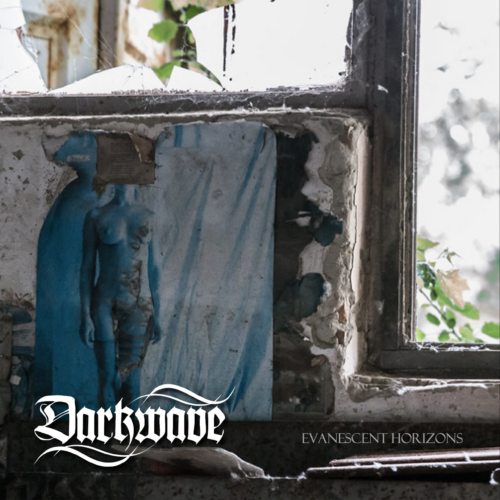
The cover artwork of Evanescent Horizons may seem somewhat unusual at first glance, but it reflects many of the album’s central themes. The photograph itself – as with all visuals accompanying Evanescent Horizons – was taken by my talented friend, photographer Dávid Ujhelyi. His remarkable eye for atmosphere and detail helped bring the album’s visual world to life.

The decaying industrial setting serves as a reminder of transience, deterioration, and the inevitable passing of all things. In many ways, it represents the point from which the album begins: the confrontation with loss, impermanence, and the realization that what we love cannot always be preserved.

At the center stands a blue female figure whose presence intentionally echoes the cover of Horror Sacri. There, a similarly colored figure represented the Virgin Mary and reflected that album’s focus on the sacred and the transcendent. Here, however, the figure is simply an ordinary human being. She is naked, vulnerable, and her face is deliberately concealed. By removing her individual identity, the image suggests that the story told on Evanescent Horizons is not about one specific person, but about something universal. The woman becomes a symbol rather than a portrait.

The title itself points in two directions. The horizons are behind us as much as they are ahead. The blue figure establishes a visual connection to the previous album, looking back toward themes and questions that have accompanied Darkwave for years. At the same time, the image opens a path toward something new. Perhaps the most important element of the cover is the window. It stands between the decaying interior and the bright world beyond. In many ways, it represents a threshold: the place where loss, memory, and mortality encounter hope. Beyond the rusted frame there is only light. We cannot see what lies within it, nor does the image attempt to provide certainty. The horizon remains hidden. Yet its presence is unmistakable. For me, that light symbolizes hope: not as a guarantee, but as a possibility. Not as an answer, but as a direction.

The album ultimately arrives at a similar place. It does not eliminate loss, nor does it deny decay. It does not claim to possess final answers. Instead, it asks whether something meaningful can endure despite them. The bright horizon beyond the broken window remains unseen, but it is there nonetheless. In that sense, the cover artwork mirrors the album’s final realization: we may never fully see what lies beyond the horizon, yet we can still choose to walk toward the light.

You can also listen to the album here: 🔗 https://darkwave-metal.bandcamp.com/album/evanescent-horizons

Evanescent Horizons is now available for pre-order on Bandcamp

I have spent months living with these songs. Writing them. Rewriting them. Recording them. Questioning them. Trying to make them say exactly what I wanted them to say.

On the surface, this album tells the story of loss. At a deeper level, it asks a question that refused to leave me alone: “Are there things whose value remains intact even when they seem to achieve nothing?” That question became the heart of Evanescent Horizons.

The album will be released on July 15th, but if you pre-order it now, one track will be instantly available.Thank you for listening and thank you for walking this road with me.

🔗 https://darkwave-metal.bandcamp.com/album/evanescent-horizons

What Remains When Nothing Remains? — A Journey That Became an Album

For the past months, I have lived with an album.

Not merely worked on it – lived with it. What began as a collection of songs gradually became something much more personal: a journey through hope, loss, grief, anger, acceptance, and the search for meaning beyond them all.

I am happy to finally announce that my new Darkwave album, Evanescent Horizons, will be released on July 15th.

Musically, it is a blend of progressive and symphonic metal, enriched by orchestral arrangements, church organ, neoclassical influences, thrash and death metal elements, and a few unexpected detours along the way. At its heart, however, the album asks a simple question: “Are there things whose value remains intact even when they seem to achieve nothing?” That question became the thread connecting all eleven songs.

Evanescent Horizons is, however, not ultimately about loss and grief. It is about refusing to believe that love, kindness, loyalty, and sacrifice are valuable only when they succeed. At its heart lies the conviction that some things possess an intrinsic worth independent of recognition, reward, or outcome. The protagonist loses everything he once believed he needed, yet discovers that love remains meaningful nonetheless. In the end, the album is less a tragedy than a credo: a testament to the belief that some truths—and above all, love itself—endure even when everything else fades away.

Whether many people hear it or only a few, I know that this album represents the most honest expression of what I wanted to say at this point in my life.

I look forward to sharing it with you on July 15th.

More Than an Album

For the past months, I have spent countless hours working on a new Darkwave album. Writing, arranging, recording, re-recording, mixing, doubting, rewriting, and starting over. As I am finally approaching the finish line, I find myself reflecting on what this album truly means to me.

The songs themselves are new, but their roots are much older. Most of the lyrics began their lives as poems, written long before the music existed. They were born from loss, grief, anger, love, memories, and the slow process of learning how to let go. Turning them into songs of a concept album was not simply a matter of fitting words to riffs and melodies. It meant reshaping deeply personal texts so they could live and breathe within the language of metal music without losing their original meaning.

Throughout this process, I gradually realized that this album had become something more than a collection of songs.

It became a personal statement.

A testament to what I believe about the ultimate meaning of love in its broadest sense, loss, memory, and the human capacity to endure and to create meaning that transcends our mortal reality. It tells the story of descending from joy and hope into darkness, confronting pain, rage, despair, and the overwhelming weight of absence. Yet at its core, it is not a story about defeat. It is a story about learning to live with what cannot be changed, carrying memories that never truly fade, and discovering that acceptance does not mean forgetting. Some wounds remain with us forever, but over time they cease to define us. We learn to carry them differently, and in doing so, we find a way forward without betraying what we have lost. Throughout this journey, we gradually discover a deeper meaning that extends beyond our finite lives.

Perhaps the deepest question running through the entire album is whether selfless love (and by “love” I mean the original, broader sense of the word that encompasses all forms of altruism, not merely romantic affection) possesses an intrinsic value independent of its usefulness, recognition, or reception. Whether devotion, loyalty, sacrifice, and compassion carry meaning beyond reward or even acknowledgment. I have come to believe that they do. That genuine love is not validated by acceptance, nor diminished by rejection. Its worth does not depend on whether it is reciprocated, understood, or even remembered.

The story reaches its conclusion not through triumph, but through transcendence. The protagonist ultimately accepts his own mortality, yet the love that shaped his journey does not disappear with him. It endures beyond loss, beyond failure, beyond death itself.

The path toward that conclusion is far from peaceful. There are moments of fury on this album. There are moments of sorrow. There are moments when everything seems broken beyond repair. Yet I never wanted the final message to be one of hopelessness and meaninglessness. If there is a final message hidden within these songs, it is the belief that love possesses an intrinsic value that exists independently of human judgment. It remains real even when unanswered, meaningful even when unseen, and lasting even when everything else fades away.

I do not know how this album will be received. I did not create it to chase trends, algorithms, or commercial success. I created it because I felt compelled to. Because some stories demand to be told, and some emotions refuse to stay silent. Whether many people hear it or only a few, I can honestly say that I gave it everything I had.

This album is not merely music.

It is my personal credo.