I’m pleased to share that Darkwave has been featured in Rock Hard Italy, one of Italy’s established metal magazines, in an interview titled “Il lungo addio” — “The Long Goodbye.”
The conversation with Michele Martini goes beyond the musical evolution of Evanescent Horizons. It explores the personal questions at the heart of the album: the nature of loss, the fragility of the future we imagine, and whether love retains its value when it is not returned.
These are not merely abstract philosophical questions for me. They were the starting point of an album that gradually became an exploration of something much larger: the possibility that what we give, feel and experience can retain its meaning even when life does not unfold as we hoped.
One of the central ideas behind Evanescent Horizons is that accepting loss does not mean accepting that everything we have lost was meaningless. A relationship can end. A future we imagined may never come to pass. But does that necessarily diminish the value of what we experienced along the way?
This is the question I wanted to explore through the album’s music and narrative, and it is deeply meaningful to have the opportunity to discuss it in an interview that looks beyond the sound itself and engages with the ideas behind it.
My sincere thanks to Michele Martini and Rock Hard Italy for the thoughtful questions and for giving these reflections a space of their own.
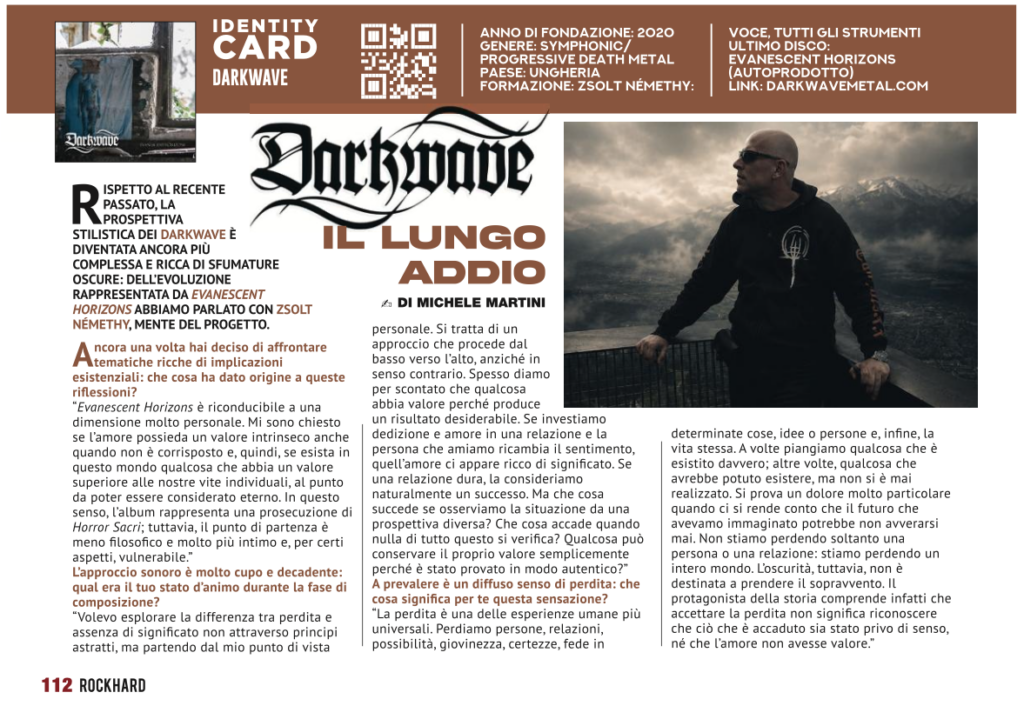
Below, you can find the original Italian magazine page, followed by the complete English translation of the interview.
Thank you for reading. 🖤
THE LONG GOODBYE
by Michele Martini
Compared to the recent past, Darkwave’s musical approach has become even more complex and rich in dark nuances. We spoke with Zsolt Némethy, the mind behind the project, about the evolution represented by Evanescent Horizons.
Once again, you have decided to explore themes rich in existential implications. What gave rise to these reflections?
“Evanescent Horizons stems from a very personal place. I asked myself whether love possesses intrinsic value even when it is not reciprocated and, consequently, whether there is anything in this world whose value exceeds that of our individual lives to such an extent that it could be considered eternal. In this sense, the album is a continuation of Horror Sacri; however, its point of departure is less philosophical and much more intimate and, in certain respects, vulnerable.”
The sonic approach is very dark and decadent. What was your state of mind during the composition process?
“I wanted to explore the difference between loss and meaninglessness not through abstract thoughts, but from my own personal perspective. It is an approach that proceeds from the bottom up rather than the other way around. We often take it for granted that something has value because it produces a desirable outcome. If we invest dedication and love in a relationship and the person we love reciprocates those feelings, that love seems full of meaning to us. If a relationship lasts, we naturally consider it a success. But what happens if we look at the situation from a different perspective? What happens when none of this comes to pass? Can something retain its value simply because it was experienced authentically?”
A pervasive sense of loss prevails. What does this feeling mean to you?
“Loss is one of the most universal human experiences. We lose people, relationships, possibilities, youth, certainties, faith in certain things, ideas or people, and ultimately life itself. Sometimes we mourn something that truly existed; at other times, we mourn something that could have existed but never came to be. A very particular kind of pain arises when we realize that the future we had imagined may never come to pass. We are not losing just a person or a relationship: we are losing an entire world. Darkness, however, is not destined to prevail. The protagonist of the story comes to understand that accepting loss does not mean acknowledging that what happened was meaningless, nor that love had no value.”
When I started Darkwave, I never expected to develop a musical identity overnight. The project began as a space where I could explore ideas without having to answer to genre conventions or anyone else’s expectations. Over the years, I have drawn from many different sources: progressive and extreme metal, classical music, orchestral arrangements, church organ, experimental textures, and the storytelling traditions that have always fascinated me.
I have never tried to hide these influences. They are part of who I am as a musician. But there has always been a question behind the process: can all these different elements become something more than the sum of their parts? Can they form a musical language that is recognizably my own?
Recent reviews of Evanescent Horizons have made me reflect on that question again.
Different Reviews, a Similar Observation
What interests me most about the responses to the album is not the ratings themselves, but the points that different reviewers have chosen to emphasize. They approach the music from different perspectives, yet some of their observations seem to converge.
Rock Hard Italy, which awarded the album 8/10, highlighted the expansion of its sonic world, the contrast between oppressive darkness and expansive instrumental passages, and the combination of elaborate baroque elements with more experimental sections. The review concludes by recognizing my inclination towards “original and distinctly personal solutions.” That phrase means a great deal to me. I have always wanted Darkwave to be more than a technically competent combination of familiar styles. I want the music to have its own character, even when it moves between very different musical worlds.
Heavy Metal Darkness, also awarding the album 8/10, approached the question from another angle. Despite raising reservations about aspects of the vocals, production and songwriting, the reviewer wrote: “Némethy sounds like his own man and the concept finally bleeds.” I find that observation particularly meaningful. The review does not suggest that every aspect of the album works equally well. Instead, it identifies moments when the music becomes unmistakably personal — when the compositional ideas, the emotional narrative and the musical expression begin to reinforce one another.
The Danish magazine Metalized, which also gave the album 8/10, focused on the variety of the compositions and the development of Darkwave since its debut, Hexapla, in 2021. The reviewer admitted that one-man projects do not usually appeal to him, as they can lack the diversity that several musicians bring to a recording. Yet Evanescent Horizons proved to be a positive surprise, with its varied compositions and expanded musical and conceptual scope.
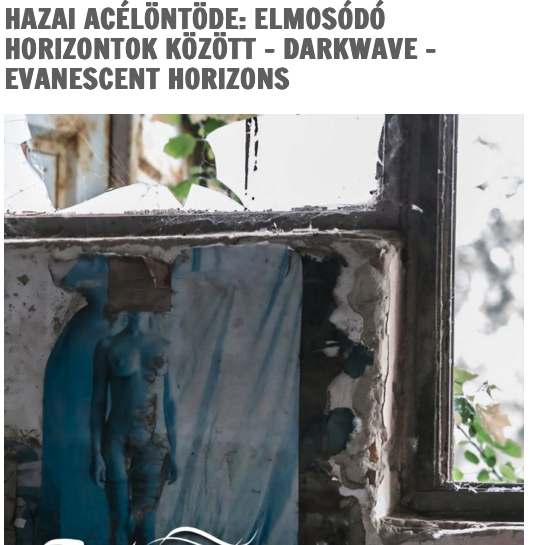
And then there is the Hungarian review published by Acélbetét (for the English translation please scroll down).
Attila Macher initially felt that Darkwave might not be entirely his musical world. As he listened, however, the album’s musical ideas drew him in. One of his central observations is that Evanescent Horizons is at its strongest when its many layers stop trying to stand out individually and come together as one dark, coherent musical image. That is an especially interesting observation to me because it describes something I consciously worked towards while making the album. With so many different elements involved, the challenge was never simply to make the music bigger, heavier or more complex. It was to make everything belong to the same world.
More Than the Sum of Its Influences
These reviews are not identical, nor do they agree on every aspect of the album. They have their own perspectives, preferences and criticisms. That is precisely what makes the recurring observation interesting. One reviewer emphasizes original and personal solutions. Another hears an artist who sounds like his own man. A third recognizes the growing diversity and conceptual scope of the project. A fourth describes how the different musical layers ultimately form a coherent whole. Taken together, these observations suggest something I have been hoping to achieve for a long time.
Darkwave is beginning to emerge, in the ears of others, not merely as a collection of influences, but as a recognizable musical language of its own.
I do not mean that the influences have disappeared. They have not, and I would never want them to. Every musician carries traces of the music that shaped them. The important question is what happens to those influences when they pass through an individual creative vision — when they are combined, transformed and placed in the service of something personal.
For me, the answer has always depended on the idea behind the music. If a story requires the weight of death metal, that is what I use. If it needs the scale of an orchestra, the resonance of a church organ, a fragile melodic passage or an unexpected change of direction, those elements have to find their place as well. Genre is a language, not a prison. The music should follow the emotional and conceptual needs of the work, rather than the other way around.
That was particularly important on Evanescent Horizons. Although the album draws on many musical traditions, I wanted its eleven tracks to form a single emotional journey — one in which the musical architecture, the recurring ideas and the contrasts between brutality and vulnerability all contribute to the same underlying narrative. The fact that different reviewers have independently recognized aspects of this approach means more to me than any single compliment could.
A Work Still in Progress
I do not see these observations as proof that Darkwave has reached some final destination. There are things I would approach differently if I made the album again. There will always be new things to learn, new ideas to explore and new limitations to overcome. But perhaps developing an artistic identity is not about reaching a point where every decision is perfect. Perhaps it is about gradually becoming more recognizable through the decisions you make — through the things you choose to combine, the risks you take, the questions you return to, and the things you refuse to simplify.
I create Darkwave music on my own, but the music does not remain entirely mine once it enters the world. Other people hear it, interpret it, disagree with it, discover things in it that I may not have anticipated, and sometimes recognize exactly what I hoped to express. That is one of the most rewarding parts of making music. I am grateful to Rock Hard Italy, Heavy Metal Darkness, Metalized and Acélbetét for taking the time to engage with Evanescent Horizons and for sharing their perspectives. Their reviews differ in tone and emphasis, but together they have given me something valuable to think about. For an independent musician, it is easy to become so absorbed in the work itself — and in the struggle to make it heard — that it becomes difficult to see what the music communicates beyond one’s own intentions. These reviews have reminded me that something is beginning to connect Darkwave may still be evolving, and I hope it always will. But perhaps its identity is becoming a little clearer, not only to me, but to those who listen. And that, for now, is a meaningful thing to discover.
Thank you for listening.
The following is an English translation of the original Hungarian review by Macher Attila, published by Acélbetét.
Once again, I have immersed myself in Hungarian underground metal, and once again, I have no regrets. What’s more, this is another one-man project from Zsolt Némethy’s workshop, and at first I thought it wasn’t quite my musical world. Then the exciting musical ideas showed me that it very much was.
If my information is correct, this is already the project’s fifth album since it started in 2021.
Stylistically, it is essentially progressive metal, built on old-school foundations, with death metal, cinematic and classical layers. Thematically, it explores loss, mortality, memory and the fragile possibilities of hope.
Let’s get into it.
Gaslight Elegy is a strong opening. The combination of narration and modern riffs already establishes the project’s distinctive direction, while the melodic guitar keeps it from becoming entirely cold.
In Blood-Sealed Solitude, the classical influence is not decoration but part of the structure. This is where the album’s musical thinking begins to become even more interesting.
But The Parchment Night goes further still: heavy metal foundations, progressive turns, church choirs and classical motifs meet here. The vocals also take a step forward: they no longer merely tell a story but become one of the defining elements of the musical atmosphere.
My favourite track on the album is The Godhook Silence, which is more direct in its own way. The classical passages accompany it in parallel, giving it a cinematic atmosphere.
Farewell to the Angel of Sardis, meanwhile, is like a story told by someone in a dark room, while the walls slowly transform into a labyrinth around them.
In On the Turning of the Years, powerful riffs, Eastern-sounding melodies and distinctive vocal layers come together. The result is music that is both heavy and mystical.
We could easily go through every track, but it is better to listen to the album. Because Evanescent Horizons is at its strongest when its many layers do not try to stand out individually, but instead come together as one great, dark musical image.
I was not disappointed: throughout the album, there is excellent musicianship, held together by strong, carefully constructed song structures. It is exciting music, but not easy listening — it keeps changing while remaining grounded in a stable, distinctive foundation.
Zsolt’s voice does not have a particularly wide range, but through narration, growls and choirs, he skilfully broadens the expressive space, ensuring that the album never becomes monotonous for a moment. This music is alive, pulsating and constantly moving.
It is an interesting journey, and I certainly do not regret boarding this ship: it sails across the musical ocean with its sails billowing, sometimes taking detours, sometimes turning in unexpected directions, but that only makes the whole voyage more exciting.
“This album draws me towards it like a force rising from the depths and slowly opening up, until suddenly I realize that I don’t want to tear myself away from it.”
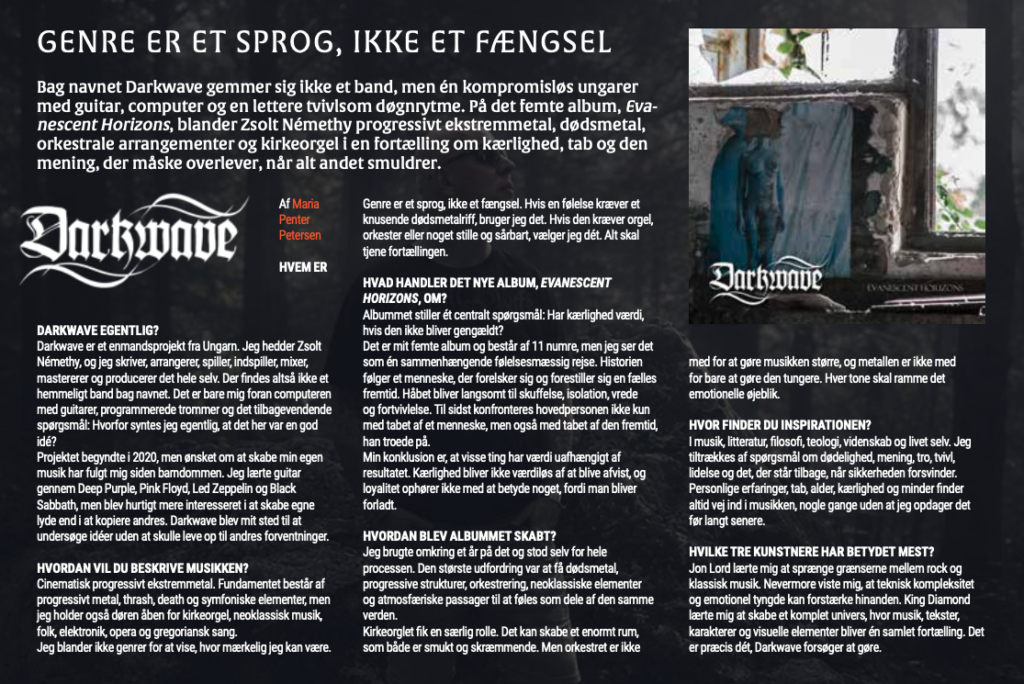
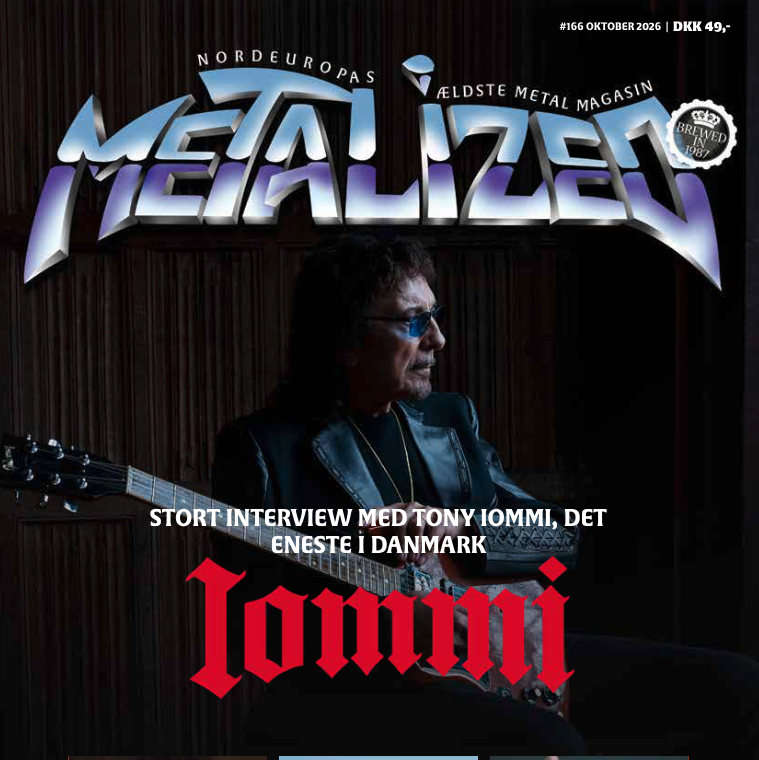
I am very happy to share that Metalized, the famous Danish metal magazine, has published a new interview with me about Darkwave and Evanescent Horizons.
The interview is titled “Genre Is a Language, Not a Prison” — a phrase that probably summarizes my approach to music better than I could have done myself.
We talk about what Darkwave is, how Evanescent Horizons came together, the ideas behind the album, and the different musical traditions that have influenced me. We also discuss the role of church organ, the album’s central question of whether love and devotion have value when they seem to accomplish nothing, and the artists who have shaped my musical thinking — e.g. Jon Lord, Nevermore and King Diamond.
I was especially pleased with the way the interview presents Darkwave: not simply as a one-person metal project, but as a place where extreme metal, classical music, atmosphere, storytelling and philosophical reflection can exist within the same musical language. One sentence from the interview perhaps says it all:
“Genre is a language, not a prison.”
That is exactly how I have always wanted to approach music. I don’t want genre boundaries to decide what a piece of music is allowed to become. The idea, emotion or story should decide that.
Many thanks to Maria Penter Petersen and Metalized for the thoughtful questions and for giving Darkwave this space. 🖤
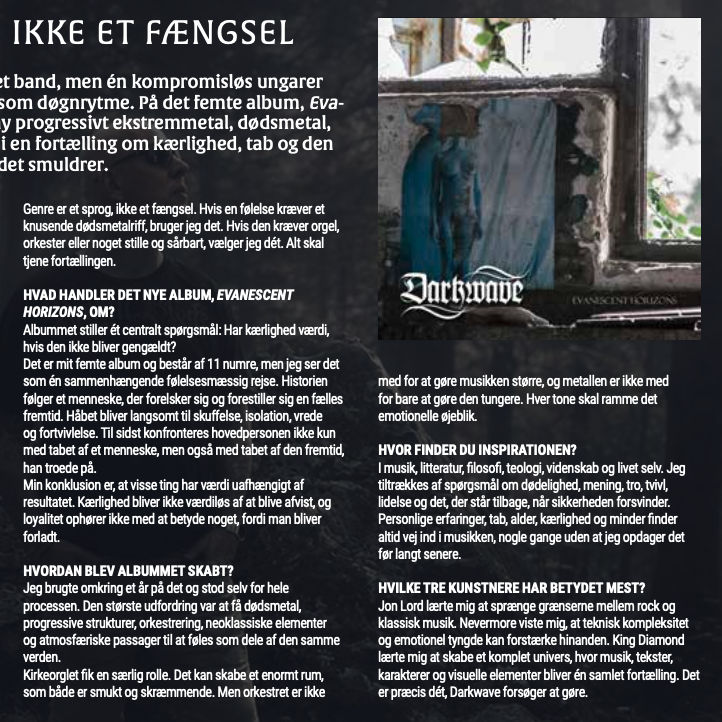
Read the full interview in the latest issue of Metalized – but for the sake of simplicity I copy it here, too (please scroll down for the English translation).
GENRE IS A LANGUAGE, NOT A PRISON
Behind the name Darkwave there is not a band, but one uncompromising Hungarian with a guitar, a computer and a slightly questionable sleep schedule. On his fifth album, Evanescent Horizons, Zsolt Némethy blends progressive extreme metal, death metal, orchestral arrangements and church organ into a story about love, loss and the meaning that may survive when everything else falls apart.
By Maria Penter Petersen
WHO IS DARKWAVE, REALLY?
Darkwave is a one-man project from Hungary. My name is Zsolt Némethy, and I write, arrange, play, record, mix, master and produce everything myself. So there is no secret band behind the name. It is just me in front of the computer with guitars, programmed drums and the recurring question: Why did I ever think this was a good idea?
The project began in 2020, but the desire to create my own music has been with me since childhood. I learned guitar through Deep Purple, Pink Floyd, Led Zeppelin and Black Sabbath, but I quickly became more interested in creating my own sounds than copying those of others. Darkwave became my place to explore ideas without having to live up to other people’s expectations.
HOW WOULD YOU DESCRIBE THE MUSIC?
Cinematic progressive extreme metal. The foundation consists of progressive metal, thrash, death and symphonic elements, but I also leave the door open to church organ, neoclassical music, folk, electronics, opera and Gregorian chant. I don’t mix genres just to show how strange I can be.
Genre is a language, not a prison. If a feeling requires a crushing death metal riff, I use it. If it requires organ, orchestra or something quiet and vulnerable, I choose that instead. Everything has to serve the story.
WHAT IS THE NEW ALBUM, EVANESCENT HORIZONS, ABOUT?
The album asks one central question: Does love have value if it is not reciprocated?
It is my fifth album and consists of 11 tracks, but I see it as one continuous emotional journey. The story follows a person who falls in love and imagines a future together. Hope slowly turns into disappointment, isolation, anger and despair. In the end, the protagonist is confronted not only with the loss of a person, but also with the loss of the future he believed in.
My conclusion is that certain things have value independently of their outcome. Love does not become worthless because it is rejected, and loyalty does not stop meaning something because you are abandoned.
HOW WAS THE ALBUM CREATED?
I spent about a year on it and handled the entire process myself. The biggest challenge was making death metal, progressive structures, orchestration, neoclassical elements and atmospheric passages feel like parts of the same world.
The church organ was given a special role. It can create an enormous space that is both beautiful and frightening. But the orchestra is not there simply to make the music bigger, and the metal is not there simply to make it heavier. Every note has to hit the emotional moment.
WHERE DO YOU FIND YOUR INSPIRATION?
In music, literature, philosophy, theology, science and life itself. I am drawn to questions about mortality, meaning, faith, doubt, suffering and what remains when certainty disappears. Personal experiences, loss, ageing, love and memories always find their way into the music, sometimes without me realizing it until much later.
WHICH THREE ARTISTS HAVE MEANT THE MOST TO YOU?
Jon Lord taught me to break down the boundaries between rock and classical music. Nevermore showed me that technical complexity and emotional weight can reinforce each other. King Diamond taught me to create a complete universe in which music, lyrics, characters and visual elements become one unified story.
That is exactly what Darkwave tries to do.
GENRE ER ET SPROG, IKKE ET FÆNGSEL
Bag navnet Darkwave gemmer sig ikke et band, men én kompromisløs ungarer med guitar, computer og en lettere tvivlsom døgnrytme. På det femte album, Evanescent Horizons, blander Zsolt Némethy progressivt ekstremmetal, dødsmetal, orkestrale arrangementer og kirkeorgel i en fortælling om kærlighed, tab og den mening, der måske overlever, når alt andet smuldrer.
Af Maria Penter Petersen
HVEM ER DARKWAVE EGENTLIG?
Darkwave er et enmandsprojekt fra Ungarn. Jeg hedder Zsolt Némethy, og jeg skriver, arrangerer, spiller, indspiller, mixer, mastererer og producerer det hele selv. Der findes altså ikke et hemmeligt band bag navnet. Det er bare mig foran computeren med guitarer, programmerede trommer og det tilbagevendende spørgsmål: Hvorfor syntes jeg egentlig, at det her var en god idé? Projektet begyndte i 2020, men ønsket om at skabe min egen musik har fulgt mig siden barndommen. Jeg lærte guitar gennem Deep Purple, Pink Floyd, Led Zeppelin og Black Sabbath, men blev hurtigt mere interesseret i at skabe egne lyde end i at kopiere andres. Darkwave blev mit sted til at undersøge idéer uden at skulle leve op til andres forventninger.
HVORDAN VIL DU BESKRIVE MUSIKKEN?
Cinematisk progressivt ekstremmetal. Fundamentet består af progressivt metal, thrash, death og symfoniske elementer, men jeg holder også døren åben for kirkeorgel, neoklassisk musik, folk, elektronik, opera og gregoriansk sang. Jeg blander ikke genrer for at vise, hvor mærkelig jeg kan være. Genre er et sprog, ikke et fængsel. Hvis en følelse kræver et knusende dødsmetalriff, bruger jeg det. Hvis den kræver orgel, orkester eller noget stille og sårbart, vælger jeg dét. Alt skal tjene fortællingen.
HVAD HANDLER DET NYE ALBUM, EVANESCENT HORIZONS, OM?
Albummet stiller ét centralt spørgsmål: Har kærlighed værdi, hvis den ikke bliver gengældt? Det er mit femte album og består af 11 numre, men jeg ser det som én sammenhængende følelsesmæssig rejse. Historien følger et menneske, der forelsker sig og forestiller sig en fælles fremtid. Håbet bliver langsomt til skuffelse, isolation, vrede og fortvivlelse. Til sidst konfronteres hovedpersonen ikke kun med tabet af et menneske, men også med tabet af den fremtid, han troede på. Min konklusion er, at visse ting har værdi uafhængigt af resultatet. Kærlighed bliver ikke værdiløs af at blive afvist, og loyalitet ophører ikke med at betyde noget, fordi man bliver forladt.
HVORDAN BLEV ALBUMMET SKABT?
Jeg brugte omkring et år på det og stod selv for hele processen. Den største udfordring var at få dødsmetal, progressive strukturer, orkestrering, neoklassiske elementer og atmosfæriske passager til at føles som dele af den samme verden. Kirkeorglet fik en særlig rolle. Det kan skabe et enormt rum, som både er smukt og skræmmende. Men orkestret er ikke med for at gøre musikken større, og metallen er ikke med for bare at gøre den tungere. Hver tone skal ramme det emotionelle øjeblik.
HVOR FINDER DU INSPIRATIONEN?
I musik, litteratur, filosofi, teologi, videnskab og livet selv. Jeg tiltrækkes af spørgsmål om dødelighed, mening, tro, tvivl, lidelse og det, der står tilbage, når sikkerheden forsvinder. Personlige erfaringer, tab, alder, kærlighed og minder finde altid vej ind i musikken, nogle gange uden at jeg opdager det før langt senere.
HVILKE TRE KUNSTNERE HAR BETYDET MEST?
Jon Lord lærte mig at sprænge grænserne mellem rock og klassisk musik. Nevermore viste mig, at teknisk kompleksitet og emotionel tyngde kan forstærke hinanden. King Diamond lærte mig at skabe et komplet univers, hvor musik, tekster, karakterer og visuelle elementer bliver én samlet fortælling. Det er præcis dét, Darkwave forsøger at gøre.
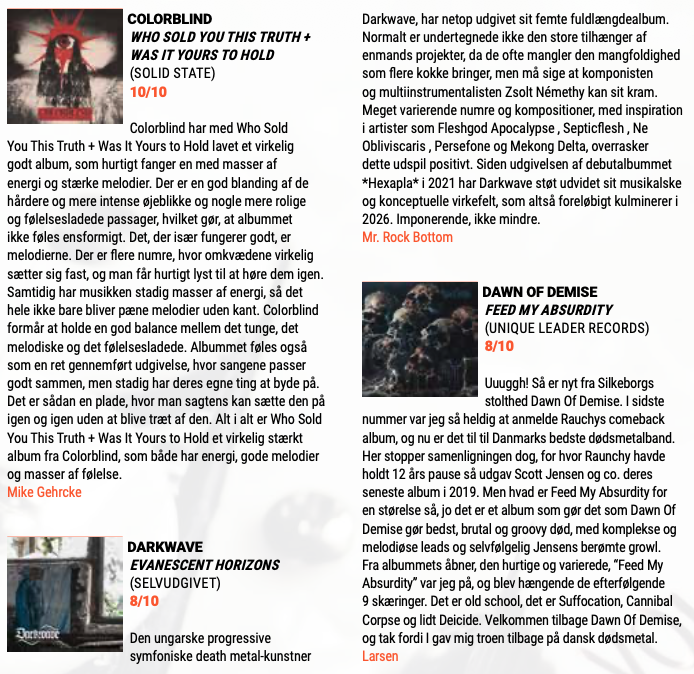
The album received an 8/10 rating, and I am particularly happy with what the reviewer chose to highlight.
The review begins with an interesting confession: he is normally not a great fan of one-man projects, as they can sometimes lack the diversity that comes from having several musicians involved. However, in the case of Darkwave, that expectation was apparently challenged.
The review describes Evanescent Horizons as a collection of highly varied songs and compositions, mentioning Fleshgod Apocalypse, Septicflesh, Ne Obliviscaris, Persefone and Mekong Delta among its reference points. More importantly, it recognizes the development of Darkwave as a project, noting how I have steadily expanded its musical and conceptual scope since the release of Hexapla in 2021. The reviewer sees Evanescent Horizons as the current culmination of that development.
That means a lot to me. This album was not created simply as another collection of songs, but as part of a much longer journey — both musically and conceptually. Seeing that journey recognized from the outside is deeply encouraging.
The full review is available in the latest issue of Metalized, but for the sake of simplicity, I post it also here.
8/10 — and “Impressive, to say the least.”
Thank you, Metalized, and thank you to Mr. Rock Bottom for giving Evanescent Horizons your time and attention. 🖤
DARKWAVE EVANESCENT HORIZONS (SELF-RELEASED) 8/10
The Hungarian progressive symphonic death metal artist Darkwave has just released his fifth full-length album. Normally, the undersigned is not a great fan of one-man projects, as they often lack the diversity that having several cooks in the kitchen can bring, but I have to say that composer and multi-instrumentalist Zsolt Némethy knows what he is doing. With highly varied songs and compositions, drawing inspiration from artists such as Fleshgod Apocalypse, Septicflesh, Ne Obliviscaris, Persefone and Mekong Delta, this release comes as a positive surprise. Since the release of the debut album Hexapla in 2021, Darkwave has steadily expanded its musical and conceptual scope, which for now reaches its culmination in 2026. Impressive, to say the least.
Mr. Rock Bottom
DARKWAVE EVANESCENT HORIZONS (SELVUDGIVET) 8/10
Den ungarske progressive symfoniske death metal-kunstner Darkwave, har netop udgivet sit femte fuldlængdealbum. Normalt er undertegnede ikke den store tilhænger af enmands projekter, da de ofte mangler den mangfoldighed som flere kokke bringer, men må sige at komponisten og multiinstrumentalisten Zsolt Némethy kan sit kram. Meget varierende numre og kompositioner, med inspiration i artister som Fleshgod Apocalypse , Septicflesh , Ne Obliviscaris , Persefone og Mekong Delta, overrasker dette udspil positivt. Siden udgivelsen af debutalbummet Hexapla i 2021 har Darkwave støt udvidet sit musikalske og konceptuelle virkefelt, som altså foreløbigt kulminerer i 2026. Imponerende, ikke mindre.