When I started Darkwave, I never expected to develop a musical identity overnight. The project began as a space where I could explore ideas without having to answer to genre conventions or anyone else’s expectations. Over the years, I have drawn from many different sources: progressive and extreme metal, classical music, orchestral arrangements, church organ, experimental textures, and the storytelling traditions that have always fascinated me.
I have never tried to hide these influences. They are part of who I am as a musician. But there has always been a question behind the process: can all these different elements become something more than the sum of their parts? Can they form a musical language that is recognizably my own?
Recent reviews of Evanescent Horizons have made me reflect on that question again.
Different Reviews, a Similar Observation
What interests me most about the responses to the album is not the ratings themselves, but the points that different reviewers have chosen to emphasize. They approach the music from different perspectives, yet some of their observations seem to converge.
Rock Hard Italy, which awarded the album 8/10, highlighted the expansion of its sonic world, the contrast between oppressive darkness and expansive instrumental passages, and the combination of elaborate baroque elements with more experimental sections. The review concludes by recognizing my inclination towards “original and distinctly personal solutions.” That phrase means a great deal to me. I have always wanted Darkwave to be more than a technically competent combination of familiar styles. I want the music to have its own character, even when it moves between very different musical worlds.
Heavy Metal Darkness, also awarding the album 8/10, approached the question from another angle. Despite raising reservations about aspects of the vocals, production and songwriting, the reviewer wrote: “Némethy sounds like his own man and the concept finally bleeds.” I find that observation particularly meaningful. The review does not suggest that every aspect of the album works equally well. Instead, it identifies moments when the music becomes unmistakably personal — when the compositional ideas, the emotional narrative and the musical expression begin to reinforce one another.
The Danish magazine Metalized, which also gave the album 8/10, focused on the variety of the compositions and the development of Darkwave since its debut, Hexapla, in 2021. The reviewer admitted that one-man projects do not usually appeal to him, as they can lack the diversity that several musicians bring to a recording. Yet Evanescent Horizons proved to be a positive surprise, with its varied compositions and expanded musical and conceptual scope.
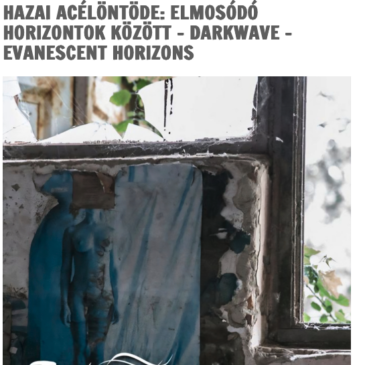
And then there is the Hungarian review published by Acélbetét (for the English translation please scroll down).
Attila Macher initially felt that Darkwave might not be entirely his musical world. As he listened, however, the album’s musical ideas drew him in. One of his central observations is that Evanescent Horizons is at its strongest when its many layers stop trying to stand out individually and come together as one dark, coherent musical image. That is an especially interesting observation to me because it describes something I consciously worked towards while making the album. With so many different elements involved, the challenge was never simply to make the music bigger, heavier or more complex. It was to make everything belong to the same world.
More Than the Sum of Its Influences
These reviews are not identical, nor do they agree on every aspect of the album. They have their own perspectives, preferences and criticisms. That is precisely what makes the recurring observation interesting. One reviewer emphasizes original and personal solutions. Another hears an artist who sounds like his own man. A third recognizes the growing diversity and conceptual scope of the project. A fourth describes how the different musical layers ultimately form a coherent whole. Taken together, these observations suggest something I have been hoping to achieve for a long time.
Darkwave is beginning to emerge, in the ears of others, not merely as a collection of influences, but as a recognizable musical language of its own.
I do not mean that the influences have disappeared. They have not, and I would never want them to. Every musician carries traces of the music that shaped them. The important question is what happens to those influences when they pass through an individual creative vision — when they are combined, transformed and placed in the service of something personal.
For me, the answer has always depended on the idea behind the music. If a story requires the weight of death metal, that is what I use. If it needs the scale of an orchestra, the resonance of a church organ, a fragile melodic passage or an unexpected change of direction, those elements have to find their place as well. Genre is a language, not a prison. The music should follow the emotional and conceptual needs of the work, rather than the other way around.
That was particularly important on Evanescent Horizons. Although the album draws on many musical traditions, I wanted its eleven tracks to form a single emotional journey — one in which the musical architecture, the recurring ideas and the contrasts between brutality and vulnerability all contribute to the same underlying narrative. The fact that different reviewers have independently recognized aspects of this approach means more to me than any single compliment could.
A Work Still in Progress
I do not see these observations as proof that Darkwave has reached some final destination. There are things I would approach differently if I made the album again. There will always be new things to learn, new ideas to explore and new limitations to overcome. But perhaps developing an artistic identity is not about reaching a point where every decision is perfect. Perhaps it is about gradually becoming more recognizable through the decisions you make — through the things you choose to combine, the risks you take, the questions you return to, and the things you refuse to simplify.
I create Darkwave music on my own, but the music does not remain entirely mine once it enters the world. Other people hear it, interpret it, disagree with it, discover things in it that I may not have anticipated, and sometimes recognize exactly what I hoped to express. That is one of the most rewarding parts of making music. I am grateful to Rock Hard Italy, Heavy Metal Darkness, Metalized and Acélbetét for taking the time to engage with Evanescent Horizons and for sharing their perspectives. Their reviews differ in tone and emphasis, but together they have given me something valuable to think about. For an independent musician, it is easy to become so absorbed in the work itself — and in the struggle to make it heard — that it becomes difficult to see what the music communicates beyond one’s own intentions. These reviews have reminded me that something is beginning to connect Darkwave may still be evolving, and I hope it always will. But perhaps its identity is becoming a little clearer, not only to me, but to those who listen. And that, for now, is a meaningful thing to discover.
Thank you for listening.
The following is an English translation of the original Hungarian review by Macher Attila, published by Acélbetét.
DOMESTIC STEEL FOUNDRY: AMONG FADING HORIZONS — DARKWAVE — EVANESCENT HORIZONS
Once again, I have immersed myself in Hungarian underground metal, and once again, I have no regrets. What’s more, this is another one-man project from Zsolt Némethy’s workshop, and at first I thought it wasn’t quite my musical world. Then the exciting musical ideas showed me that it very much was.
If my information is correct, this is already the project’s fifth album since it started in 2021.
Stylistically, it is essentially progressive metal, built on old-school foundations, with death metal, cinematic and classical layers. Thematically, it explores loss, mortality, memory and the fragile possibilities of hope.
Let’s get into it.
Gaslight Elegy is a strong opening. The combination of narration and modern riffs already establishes the project’s distinctive direction, while the melodic guitar keeps it from becoming entirely cold.
In Blood-Sealed Solitude, the classical influence is not decoration but part of the structure. This is where the album’s musical thinking begins to become even more interesting.
But The Parchment Night goes further still: heavy metal foundations, progressive turns, church choirs and classical motifs meet here. The vocals also take a step forward: they no longer merely tell a story but become one of the defining elements of the musical atmosphere.
My favourite track on the album is The Godhook Silence, which is more direct in its own way. The classical passages accompany it in parallel, giving it a cinematic atmosphere.
Farewell to the Angel of Sardis, meanwhile, is like a story told by someone in a dark room, while the walls slowly transform into a labyrinth around them.
In On the Turning of the Years, powerful riffs, Eastern-sounding melodies and distinctive vocal layers come together. The result is music that is both heavy and mystical.
We could easily go through every track, but it is better to listen to the album. Because Evanescent Horizons is at its strongest when its many layers do not try to stand out individually, but instead come together as one great, dark musical image.
I was not disappointed: throughout the album, there is excellent musicianship, held together by strong, carefully constructed song structures. It is exciting music, but not easy listening — it keeps changing while remaining grounded in a stable, distinctive foundation.
Zsolt’s voice does not have a particularly wide range, but through narration, growls and choirs, he skilfully broadens the expressive space, ensuring that the album never becomes monotonous for a moment. This music is alive, pulsating and constantly moving.
It is an interesting journey, and I certainly do not regret boarding this ship: it sails across the musical ocean with its sails billowing, sometimes taking detours, sometimes turning in unexpected directions, but that only makes the whole voyage more exciting.
“This album draws me towards it like a force rising from the depths and slowly opening up, until suddenly I realize that I don’t want to tear myself away from it.”