Beyond the Influences: Finding a Musical Language of My Own

When I started Darkwave, I never expected to develop a musical identity overnight. The project began as a space where I could explore ideas without having to answer to genre conventions or anyone else’s expectations. Over the years, I have drawn from many different sources: progressive and extreme metal, classical music, orchestral arrangements, church organ, experimental textures, and the storytelling traditions that have always fascinated me.

I have never tried to hide these influences. They are part of who I am as a musician. But there has always been a question behind the process: can all these different elements become something more than the sum of their parts? Can they form a musical language that is recognizably my own?

Recent reviews of Evanescent Horizons have made me reflect on that question again.

Different Reviews, a Similar Observation

What interests me most about the responses to the album is not the ratings themselves, but the points that different reviewers have chosen to emphasize. They approach the music from different perspectives, yet some of their observations seem to converge.

Rock Hard Italy, which awarded the album 8/10, highlighted the expansion of its sonic world, the contrast between oppressive darkness and expansive instrumental passages, and the combination of elaborate baroque elements with more experimental sections. The review concludes by recognizing my inclination towards “original and distinctly personal solutions.” That phrase means a great deal to me. I have always wanted Darkwave to be more than a technically competent combination of familiar styles. I want the music to have its own character, even when it moves between very different musical worlds.

Heavy Metal Darkness, also awarding the album 8/10, approached the question from another angle. Despite raising reservations about aspects of the vocals, production and songwriting, the reviewer wrote: “Némethy sounds like his own man and the concept finally bleeds.” I find that observation particularly meaningful. The review does not suggest that every aspect of the album works equally well. Instead, it identifies moments when the music becomes unmistakably personal — when the compositional ideas, the emotional narrative and the musical expression begin to reinforce one another.

The Danish magazine Metalized, which also gave the album 8/10, focused on the variety of the compositions and the development of Darkwave since its debut, Hexapla, in 2021. The reviewer admitted that one-man projects do not usually appeal to him, as they can lack the diversity that several musicians bring to a recording. Yet Evanescent Horizons proved to be a positive surprise, with its varied compositions and expanded musical and conceptual scope.

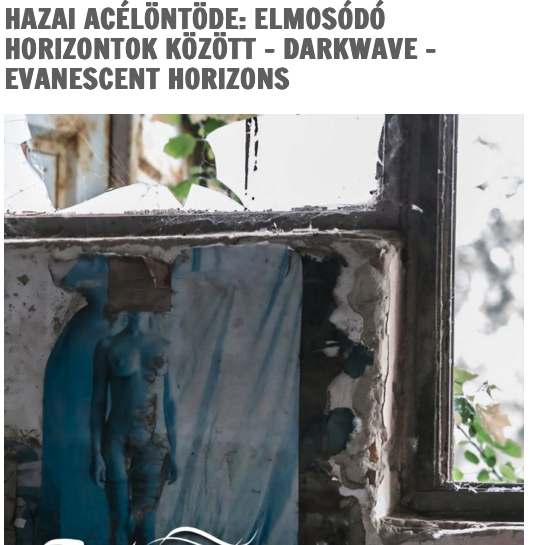
And then there is the Hungarian review published by Acélbetét (for the English translation please scroll down).

Attila Macher initially felt that Darkwave might not be entirely his musical world. As he listened, however, the album’s musical ideas drew him in. One of his central observations is that Evanescent Horizons is at its strongest when its many layers stop trying to stand out individually and come together as one dark, coherent musical image. That is an especially interesting observation to me because it describes something I consciously worked towards while making the album. With so many different elements involved, the challenge was never simply to make the music bigger, heavier or more complex. It was to make everything belong to the same world.

More Than the Sum of Its Influences

These reviews are not identical, nor do they agree on every aspect of the album. They have their own perspectives, preferences and criticisms. That is precisely what makes the recurring observation interesting. One reviewer emphasizes original and personal solutions. Another hears an artist who sounds like his own man. A third recognizes the growing diversity and conceptual scope of the project. A fourth describes how the different musical layers ultimately form a coherent whole. Taken together, these observations suggest something I have been hoping to achieve for a long time.

Darkwave is beginning to emerge, in the ears of others, not merely as a collection of influences, but as a recognizable musical language of its own.

I do not mean that the influences have disappeared. They have not, and I would never want them to. Every musician carries traces of the music that shaped them. The important question is what happens to those influences when they pass through an individual creative vision — when they are combined, transformed and placed in the service of something personal.

For me, the answer has always depended on the idea behind the music. If a story requires the weight of death metal, that is what I use. If it needs the scale of an orchestra, the resonance of a church organ, a fragile melodic passage or an unexpected change of direction, those elements have to find their place as well. Genre is a language, not a prison. The music should follow the emotional and conceptual needs of the work, rather than the other way around.

That was particularly important on Evanescent Horizons. Although the album draws on many musical traditions, I wanted its eleven tracks to form a single emotional journey — one in which the musical architecture, the recurring ideas and the contrasts between brutality and vulnerability all contribute to the same underlying narrative. The fact that different reviewers have independently recognized aspects of this approach means more to me than any single compliment could.

A Work Still in Progress

I do not see these observations as proof that Darkwave has reached some final destination. There are things I would approach differently if I made the album again. There will always be new things to learn, new ideas to explore and new limitations to overcome. But perhaps developing an artistic identity is not about reaching a point where every decision is perfect. Perhaps it is about gradually becoming more recognizable through the decisions you make — through the things you choose to combine, the risks you take, the questions you return to, and the things you refuse to simplify.

I create Darkwave music on my own, but the music does not remain entirely mine once it enters the world. Other people hear it, interpret it, disagree with it, discover things in it that I may not have anticipated, and sometimes recognize exactly what I hoped to express. That is one of the most rewarding parts of making music. I am grateful to Rock Hard Italy, Heavy Metal Darkness, Metalized and Acélbetét for taking the time to engage with Evanescent Horizons and for sharing their perspectives. Their reviews differ in tone and emphasis, but together they have given me something valuable to think about. For an independent musician, it is easy to become so absorbed in the work itself — and in the struggle to make it heard — that it becomes difficult to see what the music communicates beyond one’s own intentions. These reviews have reminded me that something is beginning to connect Darkwave may still be evolving, and I hope it always will. But perhaps its identity is becoming a little clearer, not only to me, but to those who listen. And that, for now, is a meaningful thing to discover.

Thank you for listening.


The following is an English translation of the original Hungarian review by Macher Attila, published by Acélbetét.

DOMESTIC STEEL FOUNDRY: AMONG FADING HORIZONS — DARKWAVE — EVANESCENT HORIZONS

Once again, I have immersed myself in Hungarian underground metal, and once again, I have no regrets. What’s more, this is another one-man project from Zsolt Némethy’s workshop, and at first I thought it wasn’t quite my musical world. Then the exciting musical ideas showed me that it very much was.

If my information is correct, this is already the project’s fifth album since it started in 2021.

Stylistically, it is essentially progressive metal, built on old-school foundations, with death metal, cinematic and classical layers. Thematically, it explores loss, mortality, memory and the fragile possibilities of hope.

Let’s get into it.

Gaslight Elegy is a strong opening. The combination of narration and modern riffs already establishes the project’s distinctive direction, while the melodic guitar keeps it from becoming entirely cold.

In Blood-Sealed Solitude, the classical influence is not decoration but part of the structure. This is where the album’s musical thinking begins to become even more interesting.

But The Parchment Night goes further still: heavy metal foundations, progressive turns, church choirs and classical motifs meet here. The vocals also take a step forward: they no longer merely tell a story but become one of the defining elements of the musical atmosphere.

My favourite track on the album is The Godhook Silence, which is more direct in its own way. The classical passages accompany it in parallel, giving it a cinematic atmosphere.

Farewell to the Angel of Sardis, meanwhile, is like a story told by someone in a dark room, while the walls slowly transform into a labyrinth around them.

In On the Turning of the Years, powerful riffs, Eastern-sounding melodies and distinctive vocal layers come together. The result is music that is both heavy and mystical.

We could easily go through every track, but it is better to listen to the album. Because Evanescent Horizons is at its strongest when its many layers do not try to stand out individually, but instead come together as one great, dark musical image.

I was not disappointed: throughout the album, there is excellent musicianship, held together by strong, carefully constructed song structures. It is exciting music, but not easy listening — it keeps changing while remaining grounded in a stable, distinctive foundation.

Zsolt’s voice does not have a particularly wide range, but through narration, growls and choirs, he skilfully broadens the expressive space, ensuring that the album never becomes monotonous for a moment. This music is alive, pulsating and constantly moving.

It is an interesting journey, and I certainly do not regret boarding this ship: it sails across the musical ocean with its sails billowing, sometimes taking detours, sometimes turning in unexpected directions, but that only makes the whole voyage more exciting.

“This album draws me towards it like a force rising from the depths and slowly opening up, until suddenly I realize that I don’t want to tear myself away from it.”
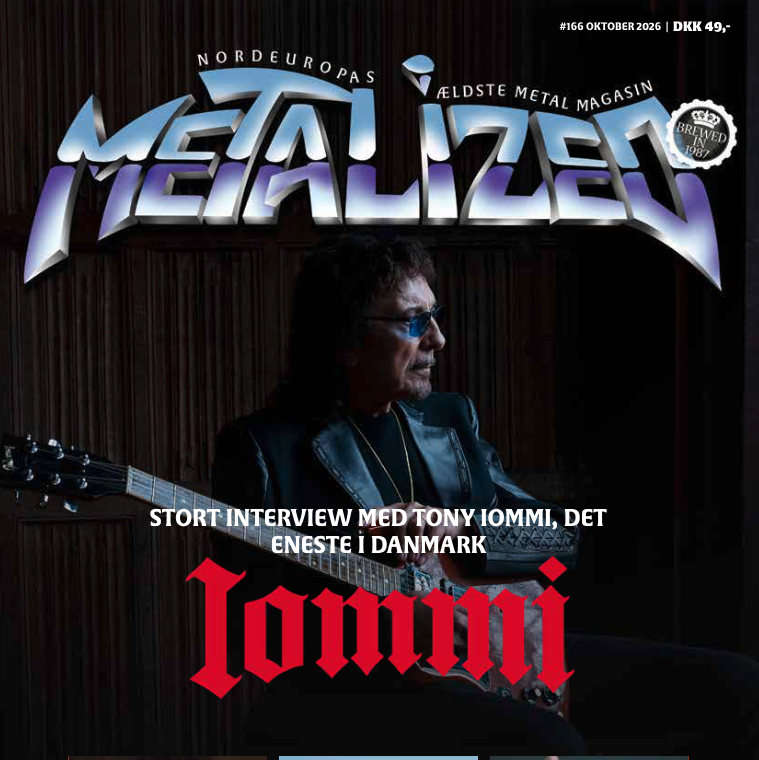
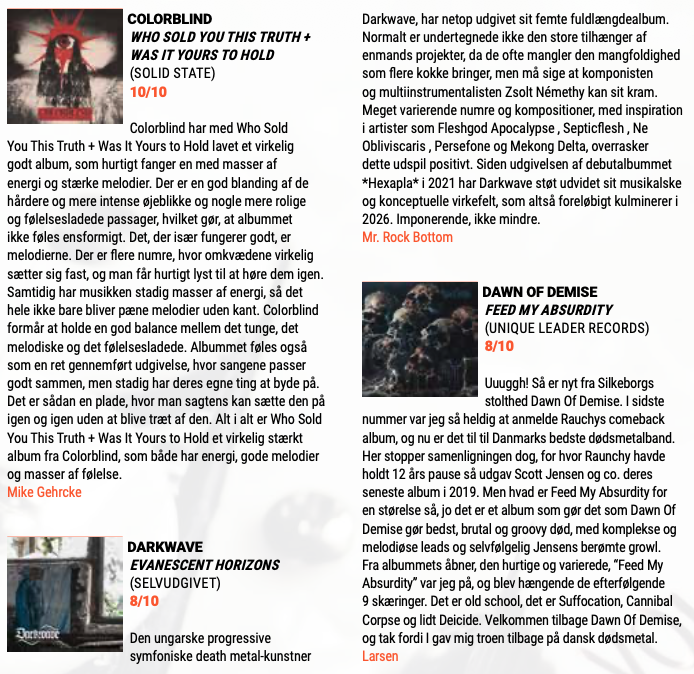
Metalized Reviews Evanescent Horizons – 8/10

Another review of Evanescent Horizons has arrived — this time from Metalized, the famous Danish metal magazine.

The album received an 8/10 rating, and I am particularly happy with what the reviewer chose to highlight.

The review begins with an interesting confession: he is normally not a great fan of one-man projects, as they can sometimes lack the diversity that comes from having several musicians involved. However, in the case of Darkwave, that expectation was apparently challenged.

The review describes Evanescent Horizons as a collection of highly varied songs and compositions, mentioning Fleshgod Apocalypse, Septicflesh, Ne Obliviscaris, Persefone and Mekong Delta among its reference points. More importantly, it recognizes the development of Darkwave as a project, noting how I have steadily expanded its musical and conceptual scope since the release of Hexapla in 2021. The reviewer sees Evanescent Horizons as the current culmination of that development.

That means a lot to me. This album was not created simply as another collection of songs, but as part of a much longer journey — both musically and conceptually. Seeing that journey recognized from the outside is deeply encouraging.

The full review is available in the latest issue of Metalized, but for the sake of simplicity, I post it also here.

8/10 — and “Impressive, to say the least.”

Thank you, Metalized, and thank you to Mr. Rock Bottom for giving Evanescent Horizons your time and attention. 🖤


DARKWAVE
EVANESCENT HORIZONS
(SELF-RELEASED)
8/10

The Hungarian progressive symphonic death metal artist Darkwave has just released his fifth full-length album. Normally, the undersigned is not a great fan of one-man projects, as they often lack the diversity that having several cooks in the kitchen can bring, but I have to say that composer and multi-instrumentalist Zsolt Némethy knows what he is doing. With highly varied songs and compositions, drawing inspiration from artists such as Fleshgod Apocalypse, Septicflesh, Ne Obliviscaris, Persefone and Mekong Delta, this release comes as a positive surprise. Since the release of the debut album Hexapla in 2021, Darkwave has steadily expanded its musical and conceptual scope, which for now reaches its culmination in 2026. Impressive, to say the least.

Mr. Rock Bottom


DARKWAVE
EVANESCENT HORIZONS

(SELVUDGIVET)
8/10

Den ungarske progressive symfoniske death metal-kunstner Darkwave, har netop udgivet sit femte fuldlængdealbum. Normalt er undertegnede ikke den store tilhænger af enmands projekter, da de ofte mangler den mangfoldighed som flere kokke bringer, men må sige at komponisten og multiinstrumentalisten Zsolt Némethy kan sit kram. Meget varierende numre og kompositioner, med inspiration i artister som Fleshgod Apocalypse , Septicflesh , Ne Obliviscaris , Persefone og Mekong Delta, overrasker dette udspil positivt. Siden udgivelsen af debutalbummet Hexapla i 2021 har Darkwave støt udvidet sit musikalske og konceptuelle virkefelt, som altså foreløbigt kulminerer i 2026. Imponerende, ikke mindre.

Mr. Rock Bottom

Heavy Metal Darkness Reviews Evanescent Horizons

Another review of Evanescent Horizons has arrived — this time from Heavy Metal Darkness, who gave the album an 8/10 rating.

What I appreciate about this review is that it takes the album seriously as a complete work. It recognizes the concept behind the eleven tracks, the emotional journey from unrequited devotion through grief, anger and acceptance, and the stubborn glimmer of hope that remains at the end. The reviewer also picked up on many of the musical elements that were important to me while making the album: blast beats and tremolo riffs colliding with strings and brass, progressive turns in the song structures, moments of fragile orchestral calm, and the overall large, cinematic character of the production. They also point out some of the influences that can be heard in Darkwave, mentioning Fleshgod Apocalypse, Septicflesh, Ne Obliviscaris, Persefone and Mekong Delta. These are all artists I have spoken about as important influences, so it was interesting to see that connection recognized from the outside.

But the review is not entirely positive, and I actually appreciate that.

The main criticism concerns the vocals. The reviewer feels that the growls remain largely within the same deep register throughout the album, and that this can flatten some of the emotional distinctions between different parts of the story — particularly between anger and acceptance. They also feel that some of the progressive passages occasionally place too many ideas on top of each other, causing the musical flow to stumble. And most importantly from a production perspective, they feel that the mix sometimes allows the orchestration to overwhelm the guitars, while the vocals lack enough variation in colour.

These are fair points to consider. Evanescent Horizons was entirely written, performed, produced, mixed and mastered by me, and working alone inevitably means that I am making decisions from inside the music rather than from the perspective of someone hearing it for the first time. There are always things that become clearer when another pair of ears approaches the finished work.

What stayed with me most, however, was a sentence near the end of the review: “Némethy sounds like his own man and the concept finally bleeds.” That sentence means a great deal to me.

One of the things I have always wanted from Darkwave is to develop a musical language that is recognizably my own. I have many influences, and I have never tried to hide them. But I don’t want Darkwave to simply reproduce the vocabulary of those influences. The whole point is to take what I have learned from different musical traditions and turn it into something personal.

Interestingly, this is something that has now appeared in two very different reviews of Evanescent Horizons. Rock Hard Italy described my approach as having a strong inclination towards “original and distinctly personal solutions.”Heavy Metal Darkness, in a completely different way, writes that I “sound like my own man.” Those are the kinds of observations that mean more to me than a numerical rating. Of course, I’m very happy with the 8/10. 🙂 But what matters even more is that someone listened closely enough to engage with the ideas, the musical architecture and the emotional intentions behind the album — and then came away with their own perspective on what works and what doesn’t. That is what a review is supposed to do.

Evanescent Horizons was a very ambitious project for one person. I tried to make it as expansive, emotional and detailed as I could, while building a coherent world across eleven chapters. I know there are things I would approach differently if I made the album again. In fact, I hope there are. The point of continuing to make music is not to reach some imaginary state of perfection, but to keep discovering what I can do next.

I’m grateful to Heavy Metal Darkness for taking the time to listen and for engaging with the album honestly.

You can read the full review on their website (and for the record, I copied the text below, too).

Heavy Metal Darkness — 8/10


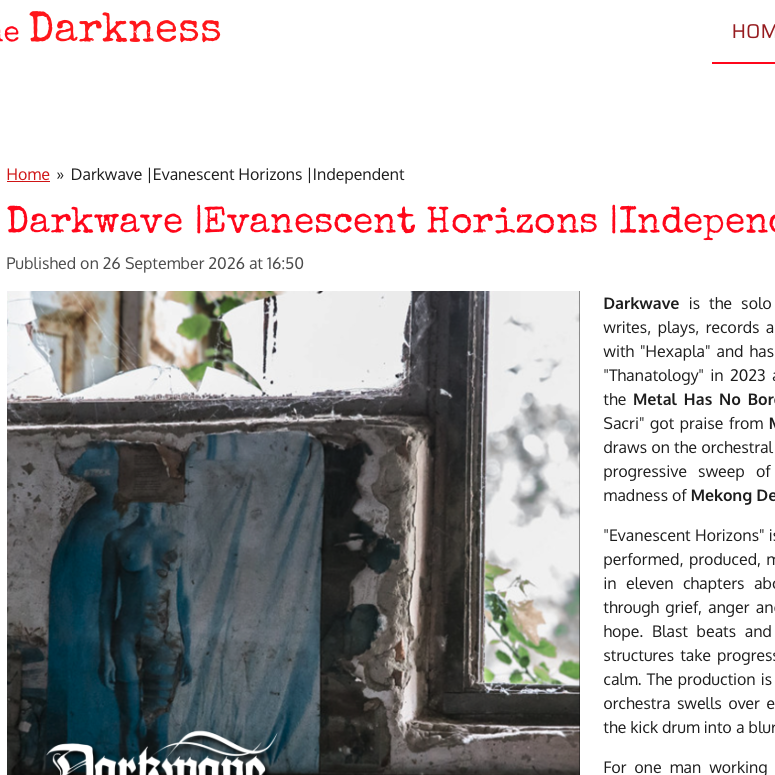
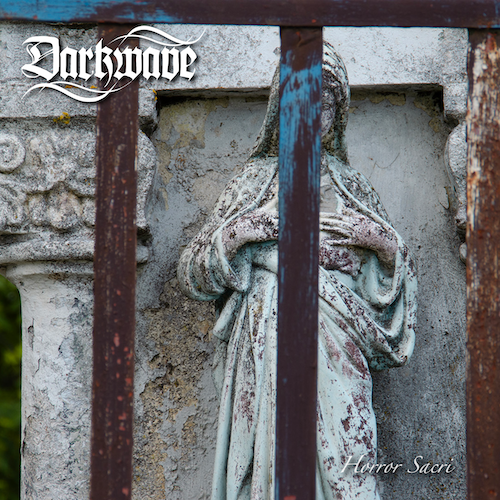
Darkwave is the solo band of Hungarian composer Zsolt Némethy, who writes, plays, records and mixes everything himself. The band started in 2021 with “Hexapla” and has barely paused since, with “Missa Innominata” in 2022, “Thanatology” in 2023 and “Horror Sacri” in 2025. “Thanatology” made it into the Metal Has No Borders readers’ album of the year rankings, and “Horror Sacri” got praise from Metal Digest and Rock Hard Italy. Musically, the band draws on the orchestral bombast of Fleshgod Apocalypse and Septicflesh, the progressive sweep of Ne Obliviscaris and Persefone, and the classical madness of Mekong Delta.

“Evanescent Horizons” is the fifth album. Once again Némethy wrote, arranged, performed, produced, mixed and mastered all of it alone. It’s a concept album in eleven chapters about a soul wrecked by unrequited devotion, moving through grief, anger and acceptance until it reaches a faint, stubborn glow of hope. Blast beats and tremolo riffs crash into strings and brass, the song structures take progressive turns, and there are moments of fragile orchestral calm. The production is big and cinematic. When the arrangements pile up, the orchestra swells over everything, pushing the guitars to the back and turning the kick drum into a blur during the fastest blasts.

For one man working alone, the scale here is impressive, and the heaviest moments crush. The growls stay locked in one deep register across most of the eleven tracks. That dulls the emotional arc the concept promises, because anger and acceptance end up sounding the same. The Septicflesh and Fleshgod Apocalypse blueprint shows through in the orchestral hooks more than once.

The progressive detours sometimes stack one idea on top of another until the flow stumbles. When the guitars stop blasting and lock into melodic lines with the strings, climbing toward those rare glimpses of hope, Némethy sounds like his own man and the concept finally bleeds. This is a big, heartfelt and ambitious album, held back from greatness by a mix that swallows its own guitars and vocals that never change color.

8.0

Rock Hard Italy on Evanescent Horizons

Receiving a review is always a strange experience for me. When you spend roughly a year alone writing, recording, arranging, producing, mixing and mastering an album, you inevitably become very close to it. You know where every sound came from, why a particular instrument enters at a certain moment, what a lyric means to you, and which seemingly insignificant detail took hours to get right. And because of that, it is not always easy to know what remains of all those intentions when the music finally leaves your hands. That is why I always find it particularly meaningful when someone listens carefully enough to discover something beyond the obvious.

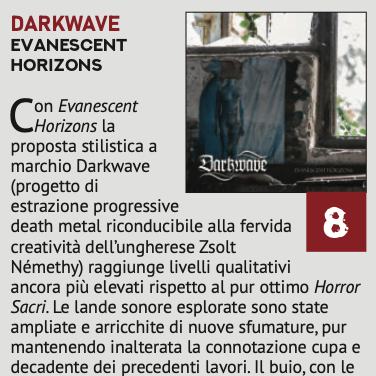
Evanescent Horizons has now received a review from Rock Hard Italy, earning a 8/10 rating, and I was genuinely moved by the way they approached the album. They describe it as reaching “even higher levels of quality” than Horror Sacri, but what means even more to me is what they chose to focus on: the expansion of the sonic world, the different nuances, the contrast between oppressive darkness and more expansive instrumental passages, and the movement between elaborate baroque elements and more experimental sections. They specifically mention Gaslight Elegy, The Parchment Night and Farewell To The Angel Of Sardis as examples of these different approaches.

But perhaps the sentence that stayed with me most is the one at the end. They write about compositional and interpretative qualities, technical preparation, and, most importantly, my inclination towards “original and distinctly personal solutions.”

That is something I value enormously. I have never wanted Darkwave to be simply a technically competent version of something that already exists. I have many influences, of course, and I have never tried to hide them. But the whole point of the project has always been to find my own musical language — even if that language sometimes becomes strange, excessive, dark, quiet, orchestral, extreme or difficult to categorize. So when someone listens to the music and recognizes that attempt at individuality, it means a great deal to me.

And perhaps this is what makes independent music so strange and beautiful. There are countless musicians working away in relative obscurity, often with very limited resources and very little visibility. From the outside, much of this world is almost invisible. But occasionally the music reaches someone who listens closely enough, and suddenly that invisible connection becomes real. This review was one of those moments for me.

I’m grateful to Rock Hard Italy for taking the time to listen to Evanescent Horizons so carefully and for putting their impressions into words.

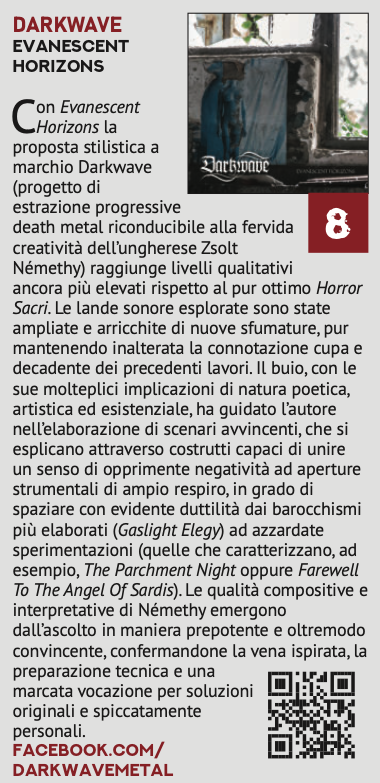
You can read the full review below, the English translation followed by the original Italian.


Rock Hard Italy — English translation of the review

With Evanescent Horizons, the stylistic approach under the Darkwave name (a progressive death metal project rooted in the fervent creativity of Hungarian artist Zsolt Némethy) reaches even higher levels of quality than the already excellent Horror Sacri. The sonic landscapes explored have been expanded and enriched with new nuances, while maintaining the dark and decadent character of the previous works. Darkness, with its many poetic, artistic and existential implications, has guided the author in the creation of compelling scenarios, expressed through structures capable of combining a sense of oppressive negativity with expansive instrumental passages. These demonstrate remarkable versatility, ranging from the most elaborate baroque elements (Gaslight Elegy) to daring experiments, such as those that characterize The Parchment Night and Farewell To The Angel Of Sardis. Némethy’s compositional and interpretative qualities emerge from the listening experience with striking force and are thoroughly convincing, confirming his inspired creative vein, technical proficiency, and a marked inclination towards original and distinctly personal solutions.

Rock Hard Italy — Italian original

Con Evanescent Horizons la proposta stilistica a marchio Darkwave (progetto di estrazione progressive death metal riconducibile alla fervida creatività dell’ungherese Zsolt Némethy) raggiunge livelli qualitativi ancora più elevati rispetto al pur ottimo Horror Sacri. Le lande sonore esplorate sono state ampliate e arricchite di nuove sfumature, pur mantenendo inalterata la connotazione cupa e decadente dei precedenti lavori. Il buio, con le sue molteplici implicazioni di natura poetica, artistica ed esistenziale, ha guidato l’autore nell’elaborazione di scenari avvincenti, che si esplicano attraverso costrutti capaci di unire un senso di opprimente negatività ad aperture strumentali di ampio respiro, in grado di spaziare con evidente duttilità dai barocchismi più elaborati (Gaslight Elegy) ad azzardate sperimentazioni (quelle che caratterizzano, ad esempio, The Parchment Night oppure Farewell To The Angel Of Sardis). Le qualità compositive e interpretative di Némethy emergono dall’ascolto in maniera prepotente e oltremodo convincente, confermandone la vena ispirata, la preparazione tecnica e una marcata vocazione per soluzioni originali e spiccatamente personali.

When a Review Becomes a Conversation

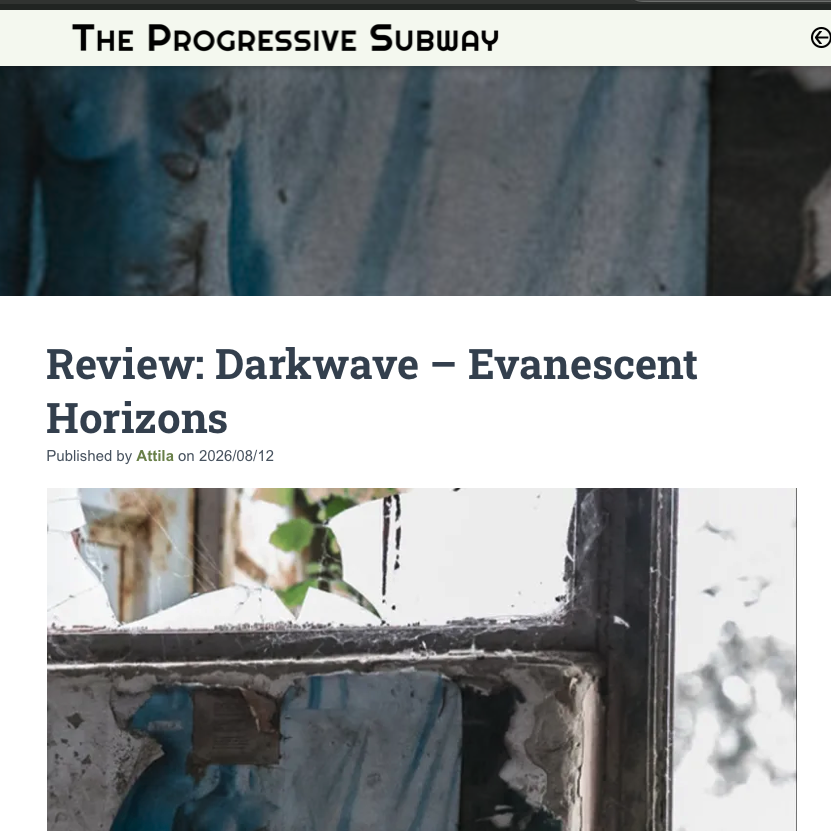
A new review of Evanescent Horizons has just appeared at The Progressive Subway, receiving a rating of 6/10.

Ratings are always a rather imperfect way of describing music, so I was more interested in what the reviewer actually had to say about the album. And there is quite a lot there to appreciate.

The reviewer understood the central idea of Evanescent Horizons: the question of whether love can have value even when it is unrequited, unrecognized, or ultimately lost. He simply doesn’t agree with my answer. And that’s perfectly fair.

There are criticisms of the music itself, too — the vocals, some of the songwriting, the classical arrangements, and the production. Some of these observations I find useful, some I don’t entirely agree with, and some are simply matters of taste. That’s what a review is supposed to do: engage with the work rather than simply approve or reject it.

What matters more to me is what the reviewer clearly found in the album. He describes it as a “wild ride worth experiencing”, praises the guitar work and the cinematic atmosphere of Transitio Mundi, and acknowledges the scale of creating a record like this as a solo project. Most importantly, he ultimately describes Evanescent Horizons as a piece of art with “surprising depth” and says it is worthy of the listener’s time. That means far more to me than the number at the bottom of the page.

I didn’t make Evanescent Horizons to be universally liked. I made it because I had something I needed to say — something I wasn’t even entirely sure I believed myself when I began writing it. A review doesn’t have to agree with the album to be meaningful. Sometimes the most interesting reviews are the ones that engage with the ideas behind the music, find something to challenge, and start a conversation.

Thank you to The Progressive Subway for listening, engaging with the record, and taking the time to write about it.

Read the full review:
The Progressive Subway — Review: Darkwave – Evanescent Horizons

Listen to the album:
Spotify / Bandcamp

Finding the Sacred in the Dark: Horror Sacri Reviewed in Rock Hard Italy

It’s always a special moment when your work finds its way into the hands of people who truly listen.
I recently had the honour of seeing Horror Sacri reviewed in Rock Hard Italy — one of the most respected metal magazines in Europe — and it received 7.5 out of 10.

What moved me even more than the rating itself were the words they chose to describe the album. They called it “a paradigm of inner exploration”, a phrase that resonated deeply with me. That’s exactly what this record was meant to be — a reflection of the human condition, of those quiet, uneasy dialogues between faith and doubt, spirit and decay, transcendence and despair.

Horror Sacri was never about adhering to genres or trends. It was an attempt to build bridges between forms of expression that are often seen as opposites: the brutality of extreme metal and the fragility of classical harmony; the bleakness of doom and the improvisational breath of jazz. To me, these are not contradictions — they are different languages that, when spoken together, tell a more complete story about who we are.

What Rock Hard Italy captured so beautifully is that Horror Sacri is not just an album — it’s a journey inward. A search for meaning in the chaos, for light in the ruins. And reading that someone else perceived it in that same way is one of the most rewarding feelings an artist can have.

I’m deeply thankful to the editors and reviewers of Rock Hard Italy for their thoughtful words, and to everyone who has taken the time to listen, reflect, and share this music.
Your attention keeps the dialogue alive.


If you haven’t had the chance to listen to the album yet, you can find Horror Sacri here — or on all major streaming platforms such as Spotify, Apple Music, and Bandcamp.
Thank you for taking the time to explore it.
And if you’d like to purchase a copy, you can do so directly here on my website, or on Bandcamp.


The screenshot below is taken from the original print edition of Rock Hard Italy, October 2025 (page 110), where the review appeared. For easier reading, I’ve also transcribed the text version and included my English translation below.

“Horror Sacri è il quarto capitolo discografico a marchio Darkwave, progetto dietro il quale si cela il musicista e compositore ungherese Zsolt Némethy. Provare a contestualizzare la natura della proposta risulta un’impresa ardua, considerando la varietà delle influenze in gioco: per contro, l’ascolto diventa un’esperienza faconda e gratificante, una volta immersi nel complesso crogiulo di idee elaborate dall’artista. Complice la presenza di due vocalist (una novità assoluta, per quanto riguarda il percorso sin qui sviluppato), Darkwave ha assunto sfumature ancora più stratificate rispetto al recente passato, aggiungendo ulteriori tasselli alla sperimentazione di intrecci che contemplano in egual misura metal estremo, doom, jazz, progressive e musica classica, tanto per citare solo alcune delle influenze. Se poi a tutto ciò si aggiungono una marcata connotazione introspettiva e riflessioni filosofiche ed esistenziali, il quadro si arricchisce ulteriormente: l’album diventa di conseguenza il paradigma di una ricerca interiore che trova nella dimensione musicale il proprio riflesso, inaugurando una nova fase di un’esplorazione condotta senza pregiudizi.”

“Horror Sacri is the fourth album released under the name Darkwave, the project led by Hungarian musician and composer Zsolt Némethy. Defining the nature of this work proves to be a challenging task, given the wide range of influences at play; yet, listening to it becomes a rich and rewarding experience once one dives into the complex crucible of ideas shaped by the artist. With the inclusion of two vocalists – an absolute first in Darkwave’s evolution – the project has taken on even more layered nuances than in the recent past, adding new dimensions to an ongoing experiment that intertwines, in equal measure, extreme metal, doom, jazz, progressive, and classical music, to name just a few of the influences. On top of all this, the strong introspective tone, along with the philosophical and existential reflections, further enrich the overall picture. As a result, the album stands as a paradigm of inner exploration, one that finds its reflection in the musical dimension, inaugurating a new phase of a journey carried out without prejudice or boundaries.”

New Milestone — and First Review for Horror Sacri

I’m thrilled to share that the first full review of my new album Horror Sacri has just been published — and by none other than Metal Digest. Reading someone else’s words about your creation is always humbling, and this review gave me more than I dared hope for.

Metal Digest describes Horror Sacri as “a bold leap” in my musical path — a transformation from purely instrumental roots into what they call a “striking vocal debut.” They highlight the album’s layered textures: symphonic swells, electronic undertones, and touches of jazz, all woven into a cinematic soundscape. But more than that, they emphasize that “rich baritone vocals and bursts of old-school riffage ground the album, giving it weight and character.”

That part struck me deeply. Stepping forward as a vocalist was one of the most stressful decisions I’ve ever made in music. Until now, all my albums had been instrumental, and this felt like stepping onto unknown ground. I carried a lot of doubts — about my own ability, about whether my voice could hold the weight of the music. To see the vocals not only accepted, but praised, was a surprise that I will hold onto with gratitude.

The review also notes that it is “an ambitious and fascinating evolution that reveals new dimensions of the project’s sound.” Reading those words reminded me of why I do this: to explore, to stretch, to take risks. To try and express more than what I can in ordinary life.

I want to say a sincere thank you to Metal Digest for giving Horror Sacri this thoughtful treatment. I’m honored that you listened, engaged, and allowed your readers to step into this world with me.

Here’s to new chapters, new sounds — and to all of you who come along for the ride. Your support and your voices mean just as much to me as any review, and I’m grateful to share this journey with you.


For the record, I insert the original text of the review here: “Hungary’s DarkWave project makes a bold leap with Horror Sacri, shifting from instrumental roots to a striking vocal debut. The record blends symphonic swells, electronic textures, and subtle jazz elements into a layered, cinematic soundscape. Yet it’s the rich baritone vocals and bursts of old-school riffage that ground the album, giving it weight and character. Themes of faith, doubt, and transcendence thread through each track, forming a series of dark, standalone vignettes. Energetic synths and intricate percussion keep the momentum alive, even when the atmosphere grows dense. While not without its uneven moments, Horror Sacri is an ambitious and fascinating evolution that reveals new dimensions of the project’s sound.”

“The David Lynch of Metal Records” – New Review on Thanatology!

I am thrilled to share an incredible review of Thanatology from The Sounds Won’t Stop, which hails the album as a “wild instrumental explosion” and “the David Lynch of metal records.”

The review praises Thanatology for its blend of heavy rock, progressive, and experimental elements, creating a cinematic and intense sonic journey. According to the reviewer, from the atmospheric opener The Last Wasted Dawn to the unpredictable Legacy of the Worthless and the epic closer Farewell Before Sunset, the album bursts with intricate textures, relentless energy, and masterful guitar work. Drumming and percussion are described as “crazy,” driving the songs forward while pushing musical boundaries. Melodic metal influences intertwine with a cinematic undercurrent, best appreciated with headphones to catch every detail. The reviewer highlights the guitar work as “some of the best lead guitar stuff I’ve heard in a long time,” with each track showcasing a different approach to shredding, from blistering solos to softer, melodic buildups. The production is also praised for its attention to detail while retaining raw energy. The integration of organs and keys with aggressive guitar work further enhances the album’s distinctive style.

The Sounds Won’t Stop urges listeners to experience Thanatology in full, as only a complete playthrough reveals its full potential.

Experience this sonic journey for yourself – play it loud!


You can find the original text of the review here. For the sake of convenience and safety, I also copy it here:

An EP release from Darkwave has a wonderful way of delivering a soiree of edgy and heavy rock tonalities that blend in with a progressive and experimental undertone and hits loads of metal elements along with plenty more but does this all with the focus on some intense and brilliantly performed guitar work.

The Thanatology EP does indeed showcase some vast undertones and cinematic backbone as it comes in with the first track called “The Last Wasted Dawn” which has an atmospheric feel and starts getting more and more intense as it plays on but, throughout all of this you have rampant and wild, experimental approaches,  riffs, and even layers of textures that come at you from left and right.

This is an intense but brilliant way to start the record because it introduces you to some of the soundscapes that you were going to hear throughout the full release.

You do have key and synth work in there, crazy percussion, and the whole thing just bursts with energy non-stop.

As the record unfolds you get more influences coming into play. The drumming and percussion throughout this record is crazy and really helps the drive for a lot of the songs so that they’re able to push the envelope the way they do.

You can certainly hear a lot of different kinds of melodic metal as an influence on this project but there is a ton of that cinematic feel as well so you do get a more expansive underbelly half the time.

There are layers to these songs and some of the best ways to listen to them or with headphones so you can pick up on all of that.

One of the most wild tracks on the record which is also one of my favorites is called “Legacy of The Worthless” and this displays a unique approach to the keys and the synth tones and performances along with how certain tracks can build in different ways.

Each of these songs comes with a bit of a rambunctious style and attitude in a way.

What really hits hard about these tracks is not just the arrangements and how outside the box some of these songs can come through. It’s really the guitar playing. This is a showcasing of some intense and unbelievable guitar work that really shows how the artist is able to pull together eclectic songwriting and have diversity all within a single track but also his guitar work.

This is some of the best lead guitar stuff that I’ve heard in a long time and every single song shows that a little differently. There’s a bit of a different approach but always a shredding and blisteringly intense sound on the guitar.

Of course, you have a lot of melodic and softer sections too that service comes before the storm or let’s songs exhale back down to a certain point.

Again, I love the vastness in the undertones of a lot of these.

The production is amazing and you can tell there was tons of attention to detail paid during the creation of these songs but it never loses this sort of character that it begins with in the first place which may even be the most important part of the entire thing.

I love the fact that organs and keys come into play and are just as chopped up and thrashy as some of the guitar work is.

This was something displayed very well on the closing track called “Farewell Before Sunset” which definitely served as an excellent closer to the record.

There are tons of harmonies, amazing melodies that come and go, thrashing metal rhythms and time signatures, endless energy, plenty of charisma, and if you are a guitar player, you absolutely have to listen to this record.

It will blow you away.

This was an absolute metal soiree that came through as a sort of wild instrumental explosion.

This was the David Lynch of metal records.

Amazing work all throughout and something you should listen to from beginning to end. Listening to one track may give you an idea of what you can expect, but it won’t give you the full spectrum of what the EP has to offer as a whole.

Listening through from beginning to end as an absolute must if you love metal or great guitar work in general.

Check this record out and experience it loud.

Another amazing review!

metal-digest.com, “The Normless Music Magazine” wrote an amazing review on Thanatology! 

„Zsolt Némthy’s one-man instrumental Metal project Darkwave bring an EP of chunky riffage, mellifluous keyboard stabs and pads and tonalities from here, there, and everywhere. This Hungarian multi-instrumentalist takes the concept of soundscaping further than almost any of his peers, and uses the furious guitar lead in lieu of vocals. You may argue that’s nothing new or extraordinary, but what there is sounds amazing (he self-produces too) and is quite beautifully written and played. Yes, there is a Proggy indulgent side, and a couple of tracks feel a little overlong. You’ll forgive that quite easily as overall this is a strong and entertaining EP.„

Check out the original post here: https://metal-digest.com/2024/01/17/darkwave-thanatology-ep/