Heavy Metal Darkness Reviews Evanescent Horizons

Another review of Evanescent Horizons has arrived — this time from Heavy Metal Darkness, who gave the album an 8/10 rating.

What I appreciate about this review is that it takes the album seriously as a complete work. It recognizes the concept behind the eleven tracks, the emotional journey from unrequited devotion through grief, anger and acceptance, and the stubborn glimmer of hope that remains at the end. The reviewer also picked up on many of the musical elements that were important to me while making the album: blast beats and tremolo riffs colliding with strings and brass, progressive turns in the song structures, moments of fragile orchestral calm, and the overall large, cinematic character of the production. They also point out some of the influences that can be heard in Darkwave, mentioning Fleshgod Apocalypse, Septicflesh, Ne Obliviscaris, Persefone and Mekong Delta. These are all artists I have spoken about as important influences, so it was interesting to see that connection recognized from the outside.

But the review is not entirely positive, and I actually appreciate that.

The main criticism concerns the vocals. The reviewer feels that the growls remain largely within the same deep register throughout the album, and that this can flatten some of the emotional distinctions between different parts of the story — particularly between anger and acceptance. They also feel that some of the progressive passages occasionally place too many ideas on top of each other, causing the musical flow to stumble. And most importantly from a production perspective, they feel that the mix sometimes allows the orchestration to overwhelm the guitars, while the vocals lack enough variation in colour.

These are fair points to consider. Evanescent Horizons was entirely written, performed, produced, mixed and mastered by me, and working alone inevitably means that I am making decisions from inside the music rather than from the perspective of someone hearing it for the first time. There are always things that become clearer when another pair of ears approaches the finished work.

What stayed with me most, however, was a sentence near the end of the review: “Némethy sounds like his own man and the concept finally bleeds.” That sentence means a great deal to me.

One of the things I have always wanted from Darkwave is to develop a musical language that is recognizably my own. I have many influences, and I have never tried to hide them. But I don’t want Darkwave to simply reproduce the vocabulary of those influences. The whole point is to take what I have learned from different musical traditions and turn it into something personal.

Interestingly, this is something that has now appeared in two very different reviews of Evanescent Horizons. Rock Hard Italy described my approach as having a strong inclination towards “original and distinctly personal solutions.”Heavy Metal Darkness, in a completely different way, writes that I “sound like my own man.” Those are the kinds of observations that mean more to me than a numerical rating. Of course, I’m very happy with the 8/10. 🙂 But what matters even more is that someone listened closely enough to engage with the ideas, the musical architecture and the emotional intentions behind the album — and then came away with their own perspective on what works and what doesn’t. That is what a review is supposed to do.

Evanescent Horizons was a very ambitious project for one person. I tried to make it as expansive, emotional and detailed as I could, while building a coherent world across eleven chapters. I know there are things I would approach differently if I made the album again. In fact, I hope there are. The point of continuing to make music is not to reach some imaginary state of perfection, but to keep discovering what I can do next.

I’m grateful to Heavy Metal Darkness for taking the time to listen and for engaging with the album honestly.

You can read the full review on their website (and for the record, I copied the text below, too).

Heavy Metal Darkness — 8/10


Darkwave is the solo band of Hungarian composer Zsolt Némethy, who writes, plays, records and mixes everything himself. The band started in 2021 with “Hexapla” and has barely paused since, with “Missa Innominata” in 2022, “Thanatology” in 2023 and “Horror Sacri” in 2025. “Thanatology” made it into the Metal Has No Borders readers’ album of the year rankings, and “Horror Sacri” got praise from Metal Digest and Rock Hard Italy. Musically, the band draws on the orchestral bombast of Fleshgod Apocalypse and Septicflesh, the progressive sweep of Ne Obliviscaris and Persefone, and the classical madness of Mekong Delta.

“Evanescent Horizons” is the fifth album. Once again Némethy wrote, arranged, performed, produced, mixed and mastered all of it alone. It’s a concept album in eleven chapters about a soul wrecked by unrequited devotion, moving through grief, anger and acceptance until it reaches a faint, stubborn glow of hope. Blast beats and tremolo riffs crash into strings and brass, the song structures take progressive turns, and there are moments of fragile orchestral calm. The production is big and cinematic. When the arrangements pile up, the orchestra swells over everything, pushing the guitars to the back and turning the kick drum into a blur during the fastest blasts.

For one man working alone, the scale here is impressive, and the heaviest moments crush. The growls stay locked in one deep register across most of the eleven tracks. That dulls the emotional arc the concept promises, because anger and acceptance end up sounding the same. The Septicflesh and Fleshgod Apocalypse blueprint shows through in the orchestral hooks more than once.

The progressive detours sometimes stack one idea on top of another until the flow stumbles. When the guitars stop blasting and lock into melodic lines with the strings, climbing toward those rare glimpses of hope, Némethy sounds like his own man and the concept finally bleeds. This is a big, heartfelt and ambitious album, held back from greatness by a mix that swallows its own guitars and vocals that never change color.

8.0
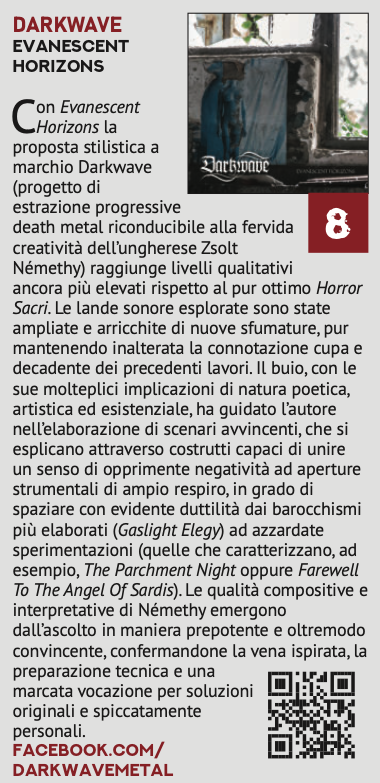
Rock Hard Italy on Evanescent Horizons

Receiving a review is always a strange experience for me. When you spend roughly a year alone writing, recording, arranging, producing, mixing and mastering an album, you inevitably become very close to it. You know where every sound came from, why a particular instrument enters at a certain moment, what a lyric means to you, and which seemingly insignificant detail took hours to get right. And because of that, it is not always easy to know what remains of all those intentions when the music finally leaves your hands. That is why I always find it particularly meaningful when someone listens carefully enough to discover something beyond the obvious.

Evanescent Horizons has now received a review from Rock Hard Italy, earning a 8/10 rating, and I was genuinely moved by the way they approached the album. They describe it as reaching “even higher levels of quality” than Horror Sacri, but what means even more to me is what they chose to focus on: the expansion of the sonic world, the different nuances, the contrast between oppressive darkness and more expansive instrumental passages, and the movement between elaborate baroque elements and more experimental sections. They specifically mention Gaslight Elegy, The Parchment Night and Farewell To The Angel Of Sardis as examples of these different approaches.

But perhaps the sentence that stayed with me most is the one at the end. They write about compositional and interpretative qualities, technical preparation, and, most importantly, my inclination towards “original and distinctly personal solutions.”

That is something I value enormously. I have never wanted Darkwave to be simply a technically competent version of something that already exists. I have many influences, of course, and I have never tried to hide them. But the whole point of the project has always been to find my own musical language — even if that language sometimes becomes strange, excessive, dark, quiet, orchestral, extreme or difficult to categorize. So when someone listens to the music and recognizes that attempt at individuality, it means a great deal to me.

And perhaps this is what makes independent music so strange and beautiful. There are countless musicians working away in relative obscurity, often with very limited resources and very little visibility. From the outside, much of this world is almost invisible. But occasionally the music reaches someone who listens closely enough, and suddenly that invisible connection becomes real. This review was one of those moments for me.

I’m grateful to Rock Hard Italy for taking the time to listen to Evanescent Horizons so carefully and for putting their impressions into words.

You can read the full review below, the English translation followed by the original Italian.


Rock Hard Italy — English translation of the review

With Evanescent Horizons, the stylistic approach under the Darkwave name (a progressive death metal project rooted in the fervent creativity of Hungarian artist Zsolt Némethy) reaches even higher levels of quality than the already excellent Horror Sacri. The sonic landscapes explored have been expanded and enriched with new nuances, while maintaining the dark and decadent character of the previous works. Darkness, with its many poetic, artistic and existential implications, has guided the author in the creation of compelling scenarios, expressed through structures capable of combining a sense of oppressive negativity with expansive instrumental passages. These demonstrate remarkable versatility, ranging from the most elaborate baroque elements (Gaslight Elegy) to daring experiments, such as those that characterize The Parchment Night and Farewell To The Angel Of Sardis. Némethy’s compositional and interpretative qualities emerge from the listening experience with striking force and are thoroughly convincing, confirming his inspired creative vein, technical proficiency, and a marked inclination towards original and distinctly personal solutions.

Rock Hard Italy — Italian original

Con Evanescent Horizons la proposta stilistica a marchio Darkwave (progetto di estrazione progressive death metal riconducibile alla fervida creatività dell’ungherese Zsolt Némethy) raggiunge livelli qualitativi ancora più elevati rispetto al pur ottimo Horror Sacri. Le lande sonore esplorate sono state ampliate e arricchite di nuove sfumature, pur mantenendo inalterata la connotazione cupa e decadente dei precedenti lavori. Il buio, con le sue molteplici implicazioni di natura poetica, artistica ed esistenziale, ha guidato l’autore nell’elaborazione di scenari avvincenti, che si esplicano attraverso costrutti capaci di unire un senso di opprimente negatività ad aperture strumentali di ampio respiro, in grado di spaziare con evidente duttilità dai barocchismi più elaborati (Gaslight Elegy) ad azzardate sperimentazioni (quelle che caratterizzano, ad esempio, The Parchment Night oppure Farewell To The Angel Of Sardis). Le qualità compositive e interpretative di Némethy emergono dall’ascolto in maniera prepotente e oltremodo convincente, confermandone la vena ispirata, la preparazione tecnica e una marcata vocazione per soluzioni originali e spiccatamente personali.

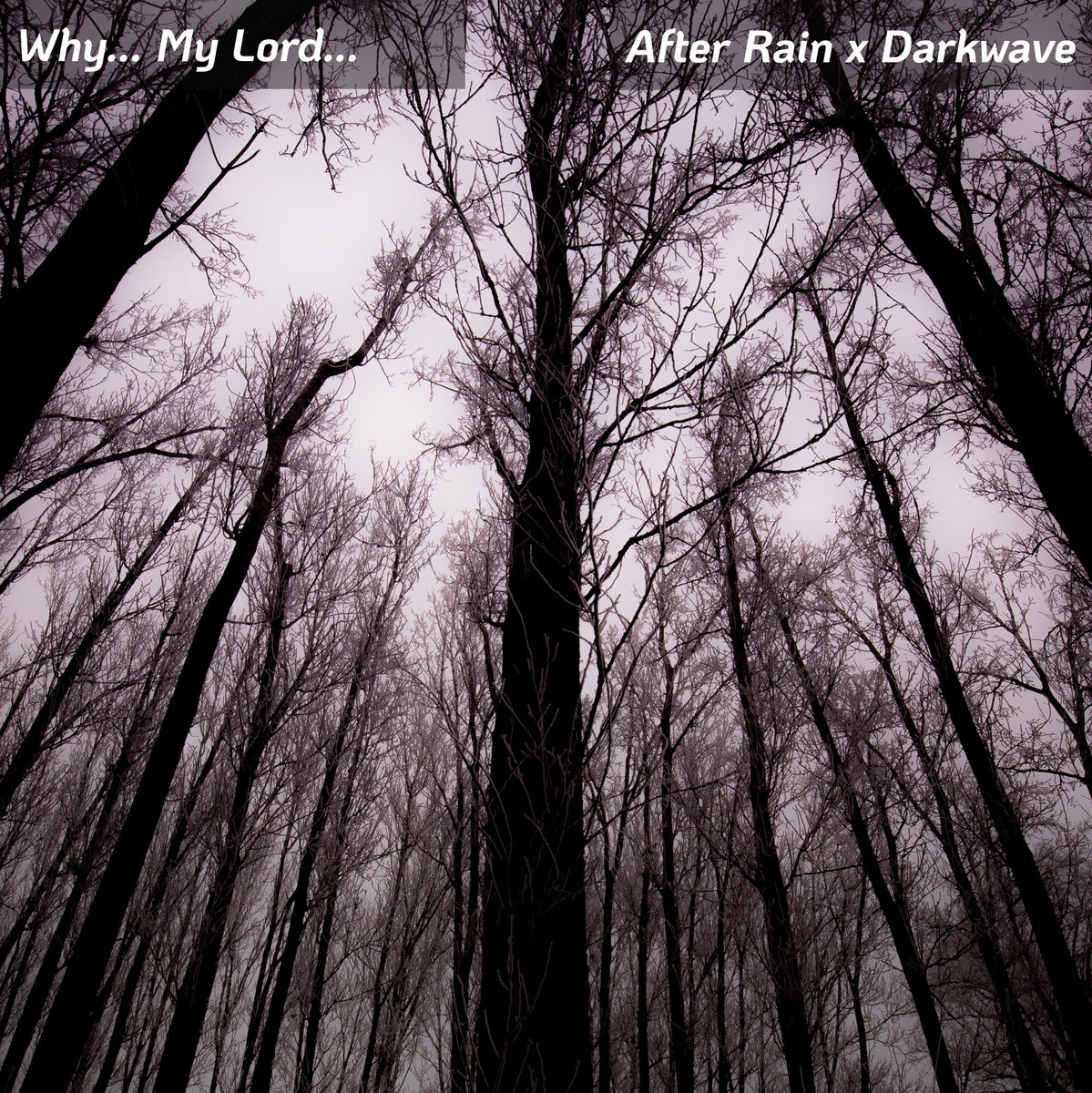
Why My Lord — A Collaboration with After Rain

Sometimes the most interesting musical encounters happen between worlds that, at first sight, seem to have very little in common.

Why My Lord is one of those encounters.

The song is a collaboration with my friend and an exceptionally talented classical composer, After Rain. He began with an emotionally charged classical composition, and I entered the picture with what I know best: extreme metal. The result is a piece that brings together two very different musical languages in order to express something they both understand surprisingly well — pain, sorrow, longing and despair.

The song was written around the feeling of believing in something that never looks back. There is a particular kind of suffering in that experience. It is not simply the pain of losing something that once existed. Sometimes the most devastating loss is the realization that what you believed might happen was never going to happen at all. You keep moving towards something that remains just beyond reach, hoping that eventually it will turn towards you. But it never does.

The composer described my contribution to the song as an attempt to give “body and soul” to the pain, sorrow and despair of believing in something that never looks back — not even in your final moments. I think that is a surprisingly accurate description of what happens when the restrained emotional language of classical music meets the physical force of extreme metal.

For me, the interesting part of this collaboration was never simply the contrast between the two styles. I have always been fascinated by what happens when seemingly incompatible musical languages are placed in the same dramatic context. Classical music can carry enormous emotional weight without needing distortion or aggression, while extreme metal can turn psychological states into something almost physical. Put them together, and the contrast itself becomes part of the storytelling. Why My Lord therefore feels less like a meeting between two genres and more like a meeting between two ways of expressing the same wound.

The visual side of the release also comes from a long-standing creative collaboration. The cover photograph was created by my friend Dávid Ujhelyi, who has photographed several Darkwave album covers, including Evanescent Horizons. His work has become an important part of the visual world surrounding my music, so I was particularly happy that he created the image for this song as well.

Why My Lord is ultimately a small experiment in what can happen when classical music and extreme metal stop treating each other as opposites.

Sometimes sorrow needs an orchestra.
Sometimes it needs a wall of distorted guitars.
And sometimes it needs both.

Listen to Why My Lord on Bandcamp.