
I’m pleased to share that Darkwave has been featured in Rock Hard Italy, one of Italy’s established metal magazines, in an interview titled “Il lungo addio” — “The Long Goodbye.”
The conversation with Michele Martini goes beyond the musical evolution of Evanescent Horizons. It explores the personal questions at the heart of the album: the nature of loss, the fragility of the future we imagine, and whether love retains its value when it is not returned.
These are not merely abstract philosophical questions for me. They were the starting point of an album that gradually became an exploration of something much larger: the possibility that what we give, feel and experience can retain its meaning even when life does not unfold as we hoped.
One of the central ideas behind Evanescent Horizons is that accepting loss does not mean accepting that everything we have lost was meaningless. A relationship can end. A future we imagined may never come to pass. But does that necessarily diminish the value of what we experienced along the way?
This is the question I wanted to explore through the album’s music and narrative, and it is deeply meaningful to have the opportunity to discuss it in an interview that looks beyond the sound itself and engages with the ideas behind it.
My sincere thanks to Michele Martini and Rock Hard Italy for the thoughtful questions and for giving these reflections a space of their own.
Below, you can find the original Italian magazine page, followed by the complete English translation of the interview.
Thank you for reading. 🖤
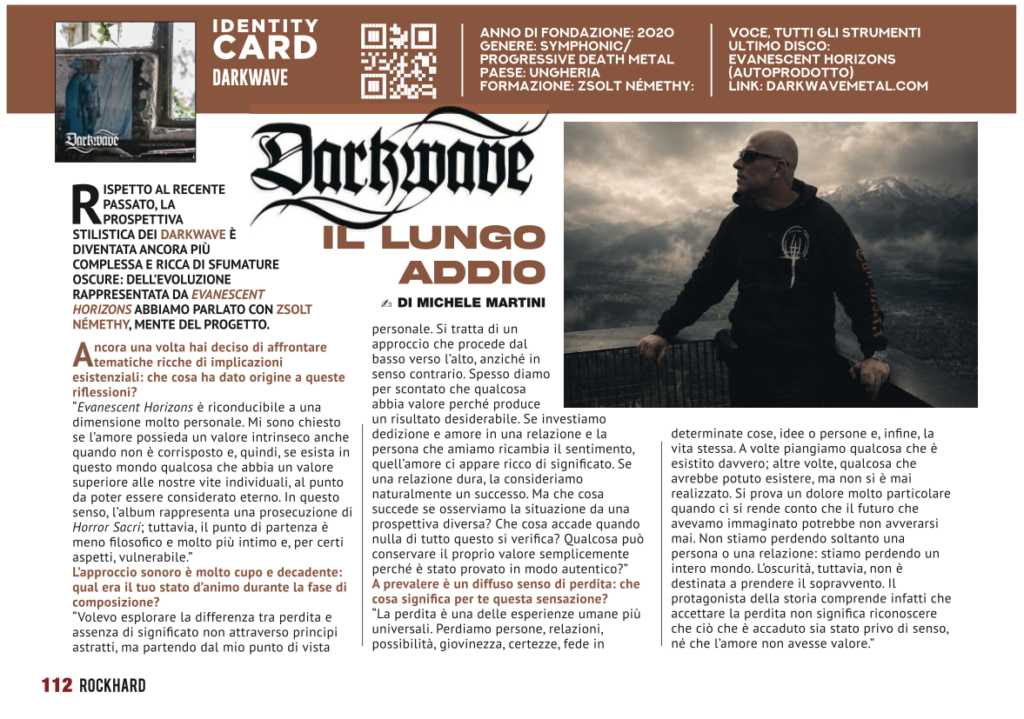
THE LONG GOODBYE
by Michele Martini
Compared to the recent past, Darkwave’s musical approach has become even more complex and rich in dark nuances. We spoke with Zsolt Némethy, the mind behind the project, about the evolution represented by Evanescent Horizons.
Once again, you have decided to explore themes rich in existential implications. What gave rise to these reflections?
“Evanescent Horizons stems from a very personal place. I asked myself whether love possesses intrinsic value even when it is not reciprocated and, consequently, whether there is anything in this world whose value exceeds that of our individual lives to such an extent that it could be considered eternal. In this sense, the album is a continuation of Horror Sacri; however, its point of departure is less philosophical and much more intimate and, in certain respects, vulnerable.”
The sonic approach is very dark and decadent. What was your state of mind during the composition process?
“I wanted to explore the difference between loss and meaninglessness not through abstract thoughts, but from my own personal perspective. It is an approach that proceeds from the bottom up rather than the other way around. We often take it for granted that something has value because it produces a desirable outcome. If we invest dedication and love in a relationship and the person we love reciprocates those feelings, that love seems full of meaning to us. If a relationship lasts, we naturally consider it a success. But what happens if we look at the situation from a different perspective? What happens when none of this comes to pass? Can something retain its value simply because it was experienced authentically?”
A pervasive sense of loss prevails. What does this feeling mean to you?
“Loss is one of the most universal human experiences. We lose people, relationships, possibilities, youth, certainties, faith in certain things, ideas or people, and ultimately life itself. Sometimes we mourn something that truly existed; at other times, we mourn something that could have existed but never came to be. A very particular kind of pain arises when we realize that the future we had imagined may never come to pass. We are not losing just a person or a relationship: we are losing an entire world. Darkness, however, is not destined to prevail. The protagonist of the story comes to understand that accepting loss does not mean acknowledging that what happened was meaningless, nor that love had no value.”