This post isn’t about me, my albums, or my songs. It’s about something much bigger.
I’m lucky – I make music purely out of passion, with no need to monetize my compositions. My tools, my ability to connect with listeners, and the freedom to create exactly what I want…? That’s more than enough for me. Honestly, I’d play the same music even if no one else ever heard it – just me, alone in a dark room. So the fact that there are people out there who connect with my songs…? That’s a privilege, and I’m profoundly grateful for it.
I don’t feel the pressure to “build a fan base” (which, as a terrible introvert, I wouldn’t even know how to do). Instead, I can focus on improving as a musician, refining my songwriting, and maintaining genuine, personal connections with those who care about my work.
But not everyone is this fortunate.
For most musicians, reaching an audience isn’t just a hope – it’s a necessity. And for us, the listeners, discovering great music should be easy. Yet, in a world where around 100,000 songs are uploaded to Spotify every single day, how does anything stand out?
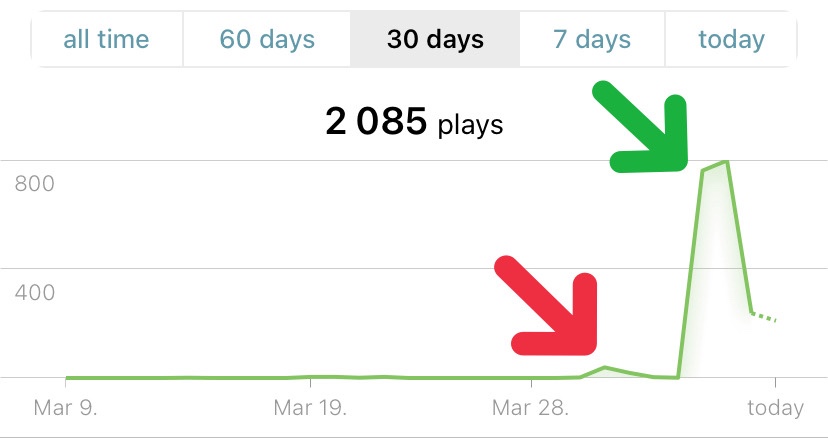
Take a look at the graph below – it’s from my BandCamp account. The green arrow marks the self-promoted release of the remastered Hexapla, (it was available for a while, before I remixed and remastered the original album), while the red arrow shows what happened when that release got featured on BandCamp’s main page. The difference is staggering. Self-promotion brought in some traffic, but a single professional boost caused a massive, yet temporary, surge in listens. The takeaway? Breaking through the “glass ceiling” as an independent artist is brutally hard – if not outright impossible – without professional help.
What does this mean?
For hobby musicians like me, numbers aren’t the ultimate goal. We don’t live off royalties or answer to labels. True support doesn’t come from faceless masses – it comes from individuals. And I cherish that. Personal feedback, even if it’s just a message or a face-to-face conversation, means infinitely more than analytics, streams, or follower counts.
But as a fan – as someone who loves music across countless rock and metal subgenres – the situation is different. The lack of clear, effective ways for independent artists to reach their audience creates a distorted reality. Musicians and their potential fans exist in separate bubbles, controlled by algorithms and the commercial interests of major labels. Think about it: how many incredible, innovative artists are out there right now that you’ve never even heard of?
Sure, Facebook ads, BandCamp features, YouTube channels, and Spotify playlists can help, but how often do you actually click on an ad for an unknown artist? The visibility problem is real. And it’s hard not to feel nostalgic for a time when discovering new music didn’t rely on algorithmic luck.
So, what’s the lesson here?
I don’t have a grand conclusion – just a realization. The impact of professional promotion on an artist’s visibility is enormous. It’s why, beyond listening to my favorite big-name bands, I actively seek out lesser-known, independent artists. Platforms like BandCamp and SoundCloud make discovery easier, but real support goes beyond streaming.
True support isn’t just a click. It’s a long-term, two-way connection between musicians and music lovers.
And that’s something no algorithm can replace.